ObserveID IVIP continuously discovers and correlates human, non-human, and AI identities across your existing identity ecosystem - turning fragmented identity data into continuously updated identity context, intelligence, and action.
An Identity Visibility & Intelligence Platform continuously discovers and correlates identities, accounts, entitlements, privileges, relationships, and activity across the identity environment. It turns fragmented data into context teams can use to understand access and emerging risk.
Identity used to mean employees and directories. Today it spans workforce users, contractors, service accounts, workloads, cloud entitlements, APIs and AI agents, across systems that were never designed to share identity context.
IGA knows governance, PAM knows privilege, IAM knows authentication and access, cloud platforms know entitlements, applications know activity.
IVIP connects those perspectives into one continuously updated identity context.
Human, non-human and AI.
SaaS, cloud and on-prem.
Standing, dynamic and machine.
Roles, access, agents and events.
A dashboard can show you a problem. ObserveID is designed to help you understand why it exists - and use the same identity context to govern and remediate it.
Aggregate identity data, surface risks, then hand remediation to another process or tool.
Use one intelligence foundation to drive governance, lifecycle automation, privileged access, remediation, and policy enforcement.
ObserveID connects identity signals, correlates relationships, maintains current state, and evaluates meaningful change - so intelligence reflects what is happening across your environment, not just a periodic snapshot.
Discovery - Normalization - Correlation - State - Relationships - Events
Who - or what - is the identity, and who owns it?
What applications, resources, roles and privileges can it access?
Why does that access exist - role, policy, request, inheritance or exception?
When was access granted, changed, used or reviewed?
Where does access exist across SaaS, cloud, hybrid and on-prem systems?
How was access obtained and how is it actually being used?
Modern identity security can't stop at employee accounts. ObserveID correlates identities to their accounts, credentials, entitlements, resources, owners, activity, and risk.
Treat the non-human identity or AI agent as the identity, not merely the account or credential it uses.
Connect people to accounts, roles, privileges, application access, activity, managers and lifecycle state.
Applications and machine identities, with ownership, credentials, accounts, permissions, resources, usage and lifecycle in one view.
Establish ownership and understand what agents can access, which identities they use, and what actions they perform.
Correlate privilege with actual usage and identity
context.
Find service identities without accountable owners or lifecycle controls.
Detect access created outside approved governance
processes.
Understand agent relationships across credentials, systems and sensitive resources.
Catch access that followed people from role to role.
See what changed before risk changed.
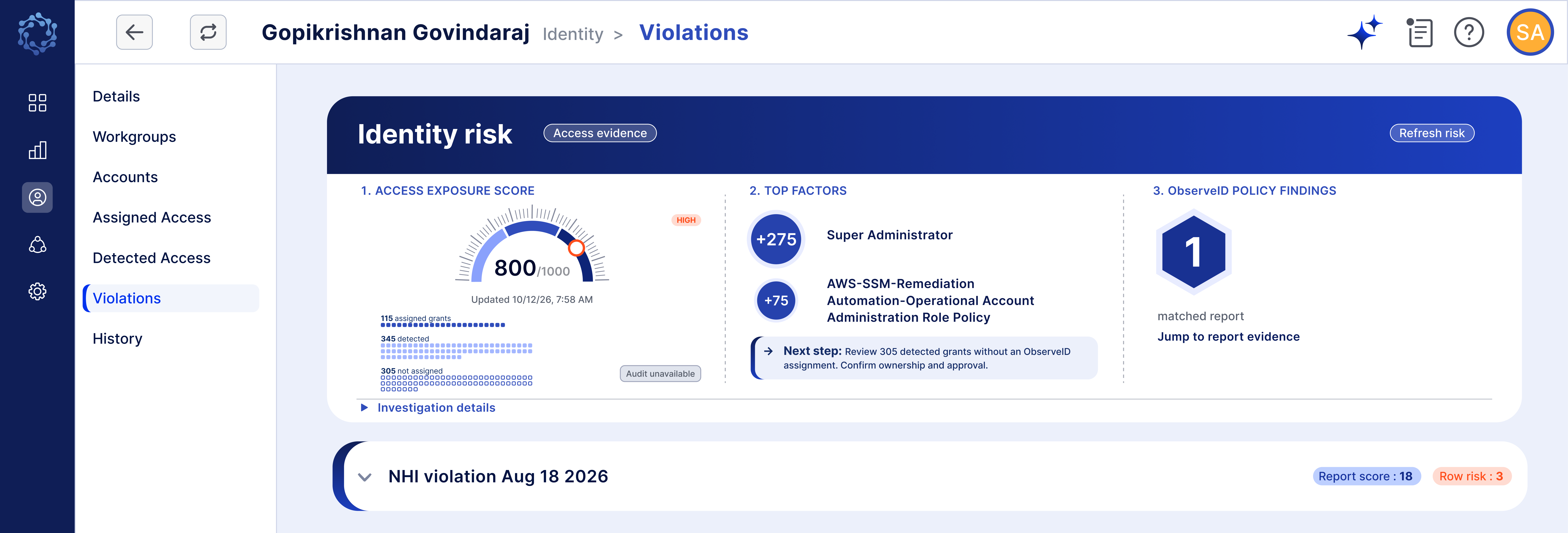
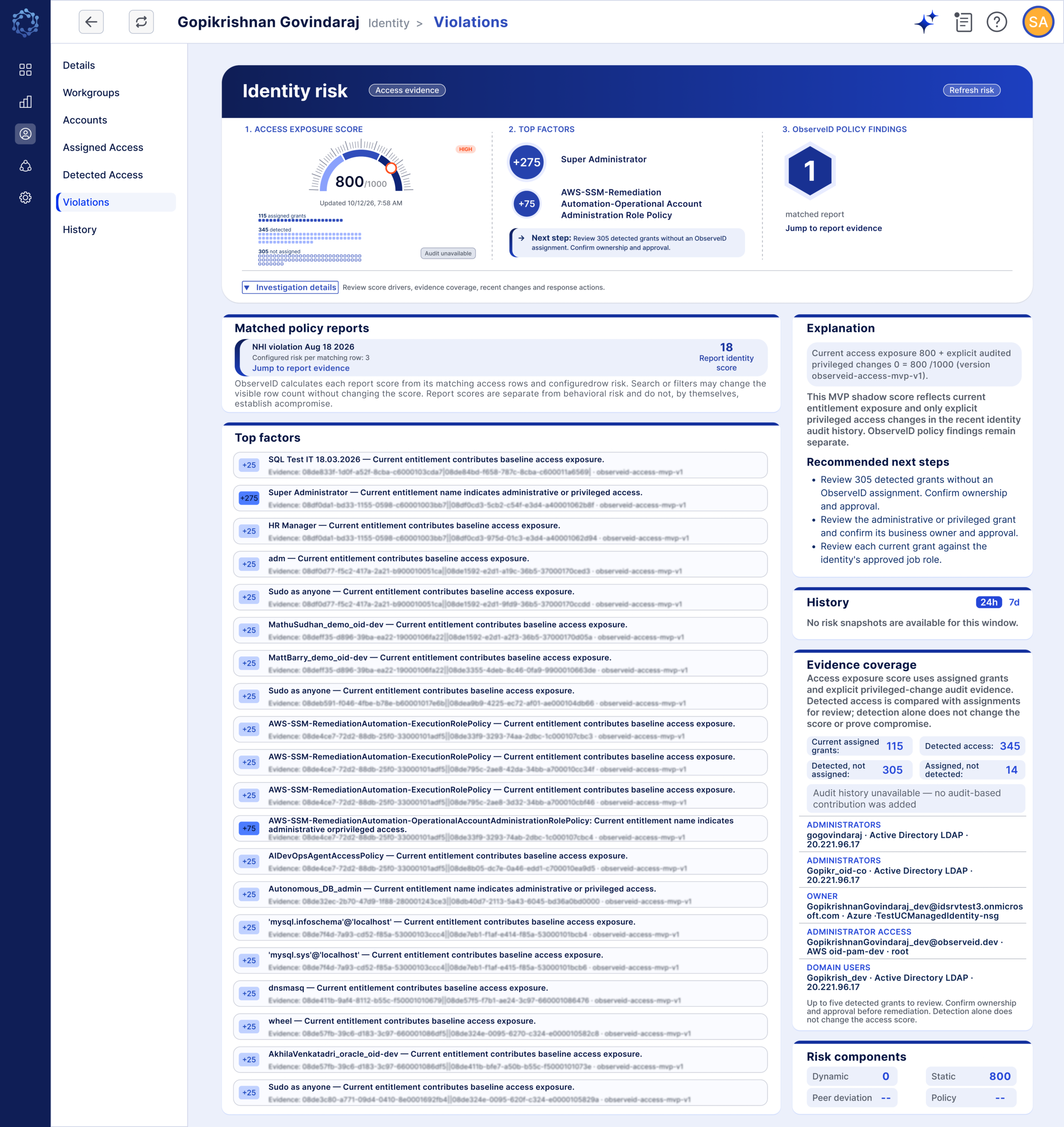
Real ObserveID screens from a demo environment: understand why an identity is exposed, trace every factor to its evidence, then manage access in the same platform.
The Identity 360 view gives each identity an access exposure score, the factors driving it, and the policy reports it matched, with a clear next step.
Identity risk panel: access exposure score, top factors and matched policy findings.
Open investigation details to see how the score was calculated, which entitlements contributed, and what the platform recommends reviewing first.
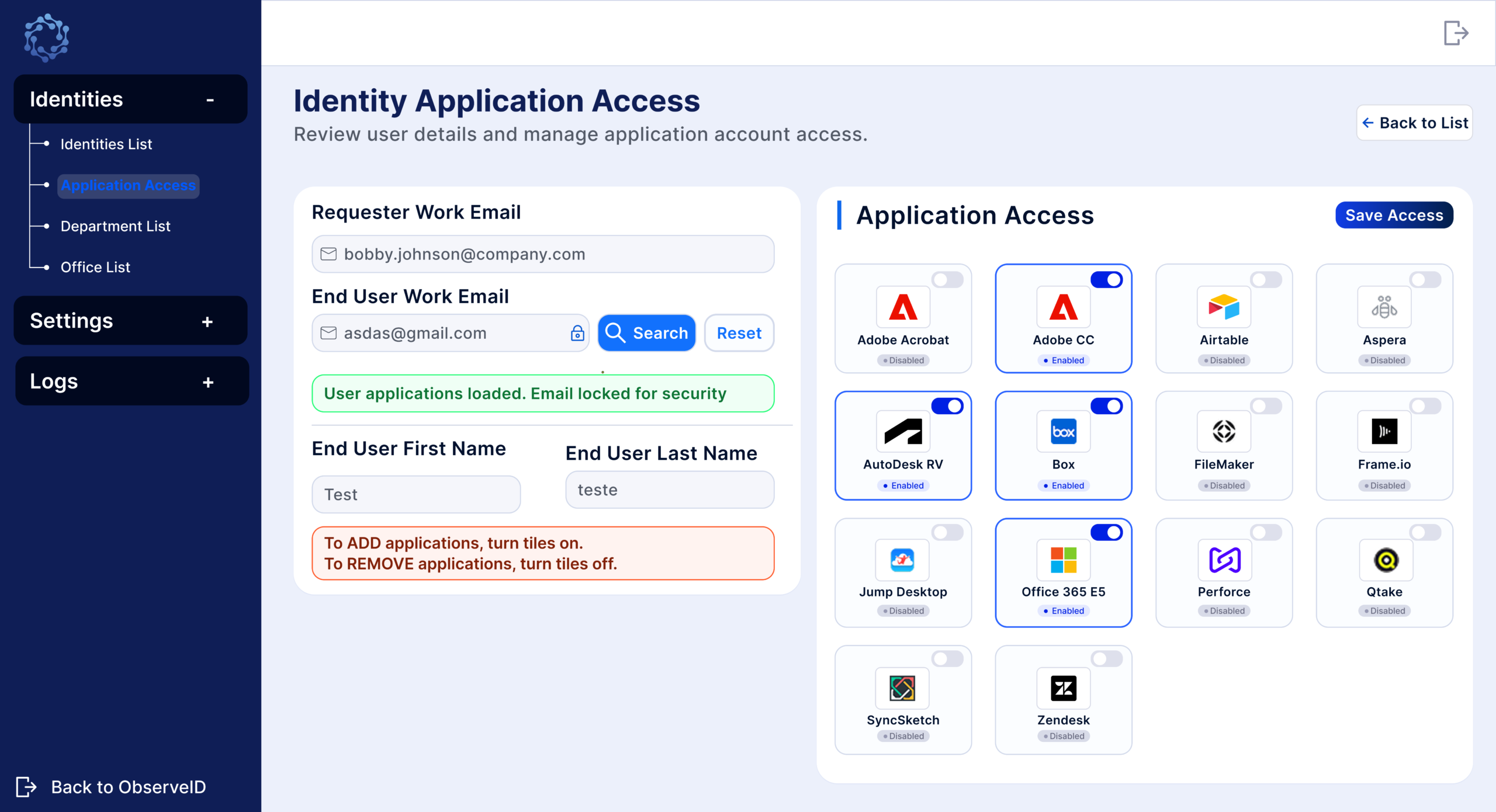
Once access is understood, review and change a person's application access from a single view. Turn tiles on to add access and off to remove it.
Identity Application Access: tile-based enable and disable per application.
Continuous identity intelligence keeps access relationships current, giving governance teams better context for certifications, investigations and audit evidence.
Discover and monitor ID and access relationships across on-prem, cloud and SaaS, so certifications start from current data.
Show who has access to what, why it exists, and when it was granted, used or reviewed, ready when auditors ask.
Automate remediation workflows while keeping approval steps in place for high-impact changes.
ESS reported automation replacing daily manual cross-checking and spreadsheet work.
Unused Azure and Oracle licenses were automatically flagged and deprovisioned.
Source: ObserveID customer case study.
ObserveID can complement the identity stack you already run. Establish cross-system intelligence first, then consolidate legacy capabilities where the business case makes sense.
Integrate directories, IAM, IGA, PAM, cloud, SaaS and business applications without starting with a rip-and-replace project.
Correlate identities, accounts, entitlements, privileges, activity, ownership and risk into unified context.
Adopt ObserveID's native IAM, IGA and PAM capabilities where consolidation can reduce complexity and cost.
250+ connectors across the directories, IAM, cloud, SaaS, HR and security tools you already run. Representative integrations shown.
Active Directory · Entra ID · Okta · Ping Identity
Workday · ADP · ServiceNow
AWS · Azure · Databricks
Microsoft 365 · Google Workspace
Splunk · Duo
Native integrations across your identity ecosystem.
Don't see your system? Ask about your stack →
OBI reasons across the ObserveID Identity Fabric to help teams investigate identity relationships, understand change, summarize risk and recommend appropriate actions.
OBI summarizes what changed, shows the ownership and access relationships behind it, and proposes actions for a person to approve.
An IVIP discovers and correlates identities, accounts, access, privileges, relationships and activity across the identity environment, then turns that data into context and intelligence for security and governance decisions.
IGA focuses primarily on governing access processes such as lifecycle management, certifications, policies and access requests. IVIP provides broader continuous visibility and intelligence across identity systems. ObserveID combines both so intelligence can drive governance and remediation.
No. ObserveID can begin as an intelligence layer across existing systems. Organizations can then adopt native ObserveID controls selectively as modernization priorities and economics justify consolidation.
Yes. ObserveID extends identity context beyond workforce users to service accounts, workloads, machine credentials and AI agents, including ownership, accounts, access, activity and risk relationships.
Freshness depends on the source. Where a system supports events, ObserveID processes changes as they happen. Otherwise it synchronizes continuously, so intelligence reflects current state rather than a periodic snapshot. Ask us for connector-level details during a demo.
IVIP provides the visibility and context layer that posture management (ISPM) and identity threat detection and response (ITDR) depend on. ObserveID pairs that layer with native controls so findings can lead to action.
Yes. Continuous discovery keeps access relationships current, so access reviews and audit reporting draw on up-to-date data instead of a once-a-year snapshot.

See how ObserveID turns fragmented identity data into context, intelligence, governance and action.