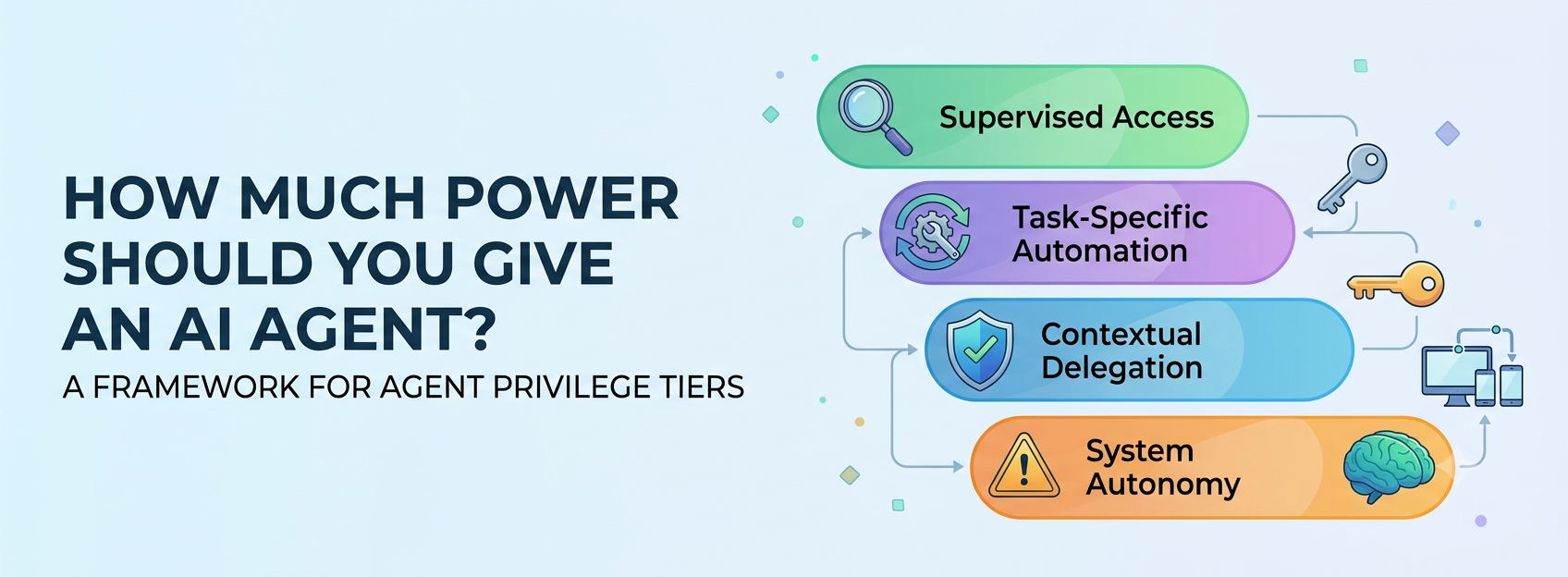
Every AI agent deployment raises the same question: how much should this agent be allowed to do? Many organizations answer it case by case. One team’s agent gets broad access because the reviewer was comfortable. Another team’s nearly identical agent gets blocked because the reviewer wasn’t. There is no shared standard behind either decision, and no way to defend it later.
This article gives you that standard. It is a four-tier privilege framework you can apply to any agent, in any department, using two questions that take minutes to answer. It also covers the rules that keep the tiers enforceable and what the framework looks like in practice.
Why agent privilege decisions need a framework
Start with the security reality. There is no reliable defense against prompt injection. An agent that reads email, browses the web, or processes documents can be fed hostile instructions, and current security guidance is direct about what follows: assume injection will succeed, and design so that a compromised agent cannot do disproportionate damage. This changes what a privilege decision is. You are not setting limits for an agent you trust. You are setting limits for whoever might take control of it.
The problem is already widespread. Okta’s research found that 80% of organizations have experienced unintended agent behavior. Regulators are moving on the same issue. The EU AI Act’s Article 14, which reaches broad enforcement in August 2026, requires that high-risk AI systems allow a human to intervene, stop, or override the system. FINRA’s 2026 Regulatory Oversight Report names agent scope creep, where agents exceed their intended authority, as a specific risk for financial firms. Both expect the same thing from you: a documented, enforceable answer to what each agent is allowed to do and who approved it.
Assign tiers to actions, not agents
The common approach is to rate the whole agent as low, medium, or high risk. This breaks down quickly, because a single agent’s workflow crosses risk levels. A travel agent reads a calendar, charges a corporate card, and emails a customer in one task. Rate the agent low and the payment is under-protected. Rate it high and a calendar lookup now requires approval, so the team routes around your process.
The unit of privilege is the action. An agent is a collection of actions, and each action carries its own risk. When you tier the actions, the agent’s total power becomes something you can see, audit, and adjust one grant at a time.
Two questions determine the tier
For each action an agent can take, answer two questions.
Can the action be undone? Reading a record causes no lasting change. Updating a record does, but a rollback exists. Sending an email, moving money, deleting data, or deploying code cannot be recalled. Reversibility matters more than data sensitivity here. A mistake in reversible territory can be corrected. The same mistake in irreversible territory is permanent.
What can the action reach? An action confined to one record in one internal system has a small blast radius. An action that touches customer-facing channels, financial systems, production infrastructure, or other identities’ permissions has a large one. Delegation belongs in this question too. An agent that can spawn sub-agents or grant access effectively reaches everything downstream of it.
These two answers place every action into one of four tiers.
The four privilege tiers
| Tier | What the agent may do | Oversight model | Credential pattern |
|---|---|---|---|
| Tier 0: Observe | Read non-sensitive data. Summarize, search, analyze. | Fully autonomous. Activity logged. | Short-lived, read-only scope |
| Tier 1: Draft | Read sensitive data. Prepare actions for a human to execute, such as drafting the email or staging the change. | Autonomous. A human performs the final step. | Short-lived, read plus staging access |
| Tier 2: Act, reversibly | Write actions with a rollback path. Update records, create tickets, modify internal documents. | Human on the loop. Autonomous execution, continuously monitored, reviewed after the fact. | Task-scoped token that expires when the task ends |
| Tier 3: Commit | Irreversible or high-blast-radius actions. External communications, payments, deletion, deployments, permission changes. | Human in the loop. Per-action approval before execution, with the agent’s reasoning and a rollback plan attached. | Just-in-time credential, single use, bound to the approval |
The oversight models are ones the industry has already settled on. Full autonomy for low-risk work, human-on-the-loop monitoring in the middle, and human-in-the-loop approval where actions cannot be recalled. The framework adds the assignment logic, so which model applies stops depending on who happens to be in the review meeting.
Here is a worked example. A customer support agent looks up an order: Tier 0. It reads the customer’s payment history to assess a refund: Tier 1. It updates the ticket status and internal notes: Tier 2. It issues the refund and emails the customer: Tier 3, with one approval covering both actions, because money moved and an external communication went out. One agent, four tiers, and every boundary can be explained to an auditor in a sentence.
Four rules keep the tiers enforceable
A tier scheme holds up only if these rules are enforced by systems, not by policy documents.
1. Delegation never escalates: A sub-agent inherits at most its parent’s tier for the delegated action. Without this rule, an attacker who compromises a Tier 1 agent can simply instruct it to spawn something more powerful.
2. Anomalies demote: When an agent’s behavior departs from its baseline, such as touching new systems or acting in unfamiliar sequences, its effective tier drops and pending Tier 2 and Tier 3 actions pause until a human reviews. The agent that most needs scrutiny is the one behaving unusually.
3. Credentials expire with the task: Standing tokens defeat the entire scheme, because a stolen credential outlives the approval attached to it. Tier 2 and Tier 3 actions run on just-in-time credentials scoped to the specific action.
4. Escalation is a request, not a drift: When an agent needs a higher tier for a new capability, that is a reviewed change with an owner’s sign-off, the same as a human requesting elevated access. FINRA’s scope creep warning describes what happens without this rule: agents accumulate authority that nobody decided to grant.
Why does this differentiate you?
The advantage is speed. Without a framework, every agent’s decision is negotiated from scratch, and the negotiation usually ends in one of two bad places. Security blocks the deployment because it has no way to assess it, and AI initiatives stall. Or the business deploys anyway, and risk accumulates until an incident forces a freeze.
With the framework, approval becomes a classification exercise. The team proposes an agent. Its actions are tiered in an afternoon. Tier 0 through Tier 2 ship immediately under standard controls, and the review conversation narrows to the few Tier 3 actions that genuinely need scrutiny.
The framework also changes what you can show externally. Enterprise customers now ask about agent controls in vendor security reviews, and regulators ask for evidence of human oversight. A tier table backed by enforcement logs answers both. An acceptable-use policy does not. In regulated industries, the ability to produce that evidence is starting to influence which vendors win deals.
How ObserveID helps
A framework is a set of decisions. It protects nothing until something enforces it, and enforcement is an identity problem. ObserveID provides that identity layer. It discovers every agent operating in your environment, including the ones deployed outside security review, and registers each as a first-class identity with a named human owner. Each agent’s granted actions and their tiers live in the same inventory as your human and machine identities, so the question of what an agent is allowed to do has one current answer.
ObserveID also enforces the rules that keep the tiers honest. It builds a behavioral baseline for every agent from observed activity, which is what makes anomaly-based demotion workable in practice. When an agent drifts from its normal pattern, ObserveID surfaces the deviation with the agent’s history and ownership attached, so a reviewer can quickly tell a new workflow from a hijacked credential. It supports short-lived, task-scoped credentials in place of standing tokens, and it tracks delegation so that a sub-agent’s actions trace back through the chain to the human responsible.
The audit evidence is a byproduct. Every agent action is logged with its tier, its approval where one was required, and its delegation context. When an auditor asks you to demonstrate that Article 14 oversight or scope controls actually operate, the evidence already exists, generated by the system as it ran.
See every agent in your environment, what it is allowed to do, and whether its behavior still matches. Book a demo with ObserveID.
Frequently asked questions
1. What are AI agent privilege tiers?
AI agent privilege tiers are risk levels assigned to the individual actions an agent can perform, each with a matching oversight model and credential type. A common structure uses four tiers: read-only observation, drafting actions for a human to execute, autonomous reversible actions with monitoring, and irreversible actions that require human approval before execution. Tiers are assigned per action rather than per agent, because a single agent’s workflow usually spans several risk levels.
2. How much access should an AI agent have?
An AI agent should have the minimum access required for each specific action it performs, granted through short-lived credentials rather than standing tokens. The two factors that determine how much oversight an action needs are whether the action can be undone and how many systems it can reach. Actions that are irreversible, such as payments, deletions, external communications, or permission changes, should require human approval each time.
3. Should AI agents ever have admin access?
Rarely as standing access. If an agent genuinely needs an administrative action, grant it as a just-in-time credential scoped to that single action, bound to a human approval, and expired immediately after use. A standing admin credential on an agent means anyone who compromises the agent, including through prompt injection, holds admin access to everything the agent can reach.
4. Which AI agent actions should require human approval?
Any action that cannot be undone or that leaves your internal environment should require pre-execution human approval. This includes sending external communications, moving money, deleting data, deploying code to production, and changing any identity’s permissions. Reversible internal actions, such as updating records or creating tickets, can run autonomously as long as they are continuously monitored and reviewed after the fact.
5. What is the difference between human-in-the-loop and human-on-the-loop for AI agents?
Human-in-the-loop means a person approves each action before the agent executes it, which suits irreversible or high-impact actions. Human-on-the-loop means the agent acts autonomously while a person monitors its activity and can intervene or review afterward, which suits reversible, lower-risk actions. A privilege tier framework tells you which model applies to which action, instead of applying one model to the entire agent.