
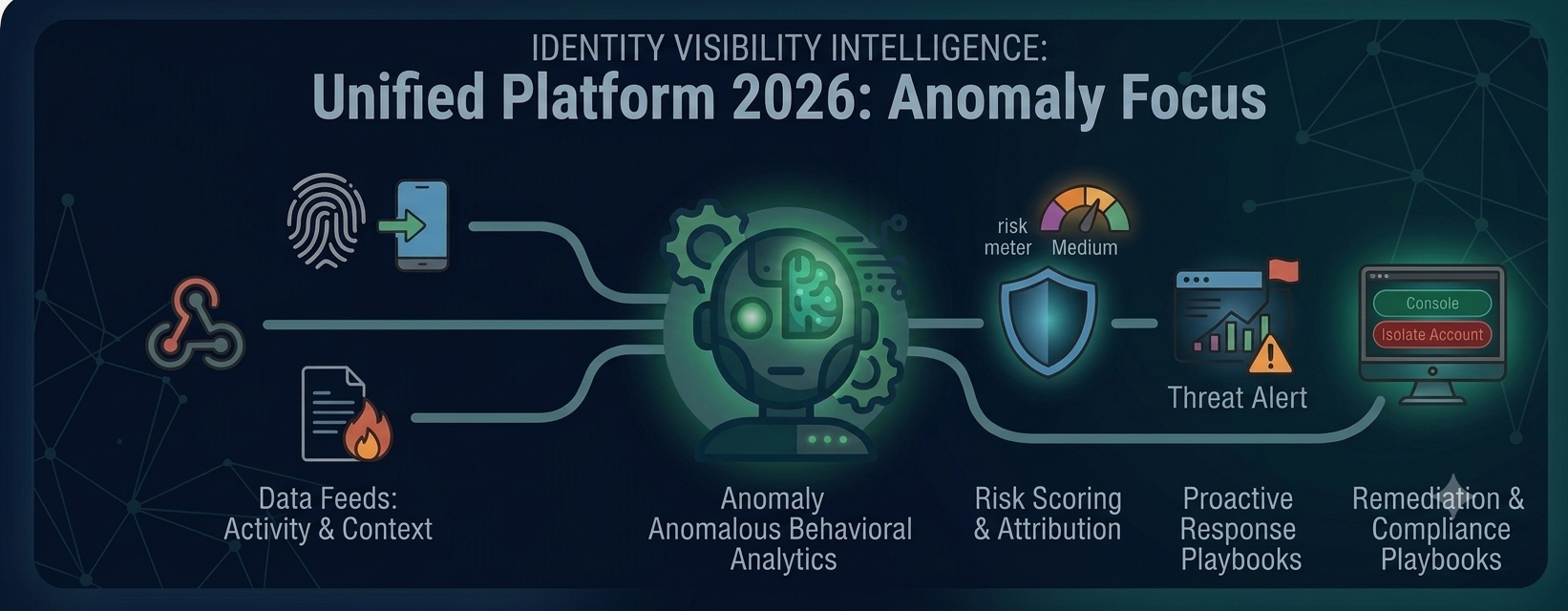
Many identity attacks no longer look like attacks. The credential is valid, the login succeeds, and the session behaves like any other. Nothing in the access policy is violated, because the attacker is using access that was legitimately granted to someone else.
That leaves behavior as the only remaining signal. When an identity starts doing something it has never done before, that deviation is often the first and only evidence that the account is no longer under its owner’s control.
This article covers what access anomalies are, which ones matter, why rule-based detection struggles with them, and how to evaluate anomaly detection when you buy it.
What is an access anomaly in identity security?
An access anomaly is activity by an identity that departs from that identity’s established pattern of behavior. It is not the same as a policy violation. A policy violation breaks a written rule, such as an access attempt that is denied because the entitlement was never granted. An anomaly breaks a pattern instead: the access is permitted, the request succeeds, and the only thing wrong is that this identity has never behaved this way before.
That distinction matters because permitted access is exactly what attackers use. Roughly 22% of breaches begin with compromised credentials, and a compromised credential produces no policy violations at all. It produces anomalies.
An anomaly is a signal, not a verdict. An engineer accessing a new system for the first time is an anomaly. So is an attacker doing the same thing with a stolen session token. What separates them is context: who owns the identity, what it normally touches, what else changed at the same time, and how much it can reach. Detection systems that surface deviations without that context produce noise. Systems that surface deviations with it produce decisions.
Types of access anomalies: From privilege escalation to impossible travel
Anomalies fall into recognizable families. The table below covers the ones that matter most in practice, along with what each one usually turns out to be.
| Anomaly type | What it looks like | What it often means |
|---|---|---|
| Impossible travel | Successful logins from geographically distant locations within an implausible time window | Frequently benign: VPNs, mobile roaming, and cloud routing produce this constantly. Meaningful only when paired with other signals. |
| Privilege escalation | An identity acquires higher permissions, or begins using elevated rights it rarely exercised | Attacker expanding access after initial compromise, or entitlement creep nobody reviewed. |
| Dormant account reactivation | An account inactive for months suddenly authenticates | Orphaned account being used by someone other than its original owner. |
| Session anomalies | A valid session token appears from a second network path or device mid-session | Session hijacking, which bypasses MFA entirely because authentication already happened. |
| Access scope expansion | An identity begins touching systems or data volumes outside its normal range | Reconnaissance, staging for exfiltration, or an agent operating outside its intended purpose. |
| Authentication pattern shifts | Repeated MFA prompts, unusual failure sequences, or new authentication methods | MFA fatigue attacks, or an attacker testing which factors are enforced. |
| Non-human identity drift | A service account or AI agent calls new APIs, runs at new times, or reaches new systems | Compromised credential, or an agent whose behavior has expanded beyond what anyone approved. |
Impossible travel deserves particular attention, because it is the anomaly everyone knows and one of the least reliable on its own. Legitimate users generate it routinely through VPN exits, roaming devices, and cloud-routed traffic, while sophisticated attackers avoid it deliberately using residential proxies and timed delays. Treated as a standalone alert, it buries analysts. Treated as one weighted input among several, it becomes useful: the same geographic anomaly means something very different from a recognized device on a corporate network than from an unfamiliar browser on a residential IP.
The last row is the one most organizations are least prepared for. Service accounts and AI agents now form the majority of the identity population, and their anomalies look nothing like human anomalies. A service account has no reason to work late or travel. Its behavior is usually so consistent that deviation is a sharper signal than it ever is for a person, provided something is actually watching it.
How IVIP platforms detect suspicious behavior vs. rule-based alerts
Rule-based detection asks a fixed question: did this activity cross a threshold someone defined in advance? It works well for known, bounded conditions. It fails in three specific ways.
- It only catches what was anticipated. Every rule encodes a failure someone already imagined. Novel attack patterns pass through untouched because no one wrote a rule for them.
- It applies one standard to every identity. A rule flagging access outside business hours is wrong for the team that works across time zones and useless for a service account that runs at 3 a.m. by design. Thresholds tuned to avoid false positives on the noisiest identities are, by definition, too loose for everyone else.
- It sees one system at a time. Rules run inside the tool that holds the data. The identity provider sees authentication. The cloud platform sees API calls. Neither sees the sequence that connects them, and 78% of insider-style incidents now involve cloud and SaaS resources, which is precisely where that fragmentation is worst.
Identity Visibility and Intelligence Platforms approach the problem from the opposite direction. Rather than asking whether activity crossed a threshold, they ask whether it fits what this specific identity normally does, and what else it correlates with.
Four mechanisms do the work. Per-identity baselines learn normal behavior for each account individually, so deviation is measured against that identity’s own history rather than a global rule. Peer group comparison adds a second reference point: an identity doing something unusual for itself but ordinary for everyone in its role is far less interesting than one doing something unusual for both. Cross-system correlation connects activity that individual tools see only in fragments, which is what turns four unremarkable events into one attack sequence. Risk scoring weighs signals together rather than alerting on each in isolation, so a geographic anomaly plus an unrecognized device plus dormant-account reactivation becomes one high-confidence alert instead of three low-confidence ones.
The practical result is fewer alerts that matter more. False positives are consistently the largest drag on detection speed, and their real cost is not wasted hours: it is that analysts become conditioned to treat every alert with the same skepticism, including the accurate ones. Context is what breaks that cycle.
One caveat worth knowing. Baselines can be poisoned. An attacker with persistent access can behave innocuously during the learning window so that their activity is absorbed into the identity’s normal profile. Mature detection guards against this by weighting recent behavior against longer histories and by treating unusually rapid baseline shifts as a signal in themselves.
Anomaly detection for compliance: SOX, HIPAA, and audit readiness
Compliance frameworks were written around access controls, but the questions auditors actually ask are increasingly behavioral.
SOX requires demonstrable control over who can affect financial reporting. Access reviews prove that entitlements were granted appropriately. Anomaly detection proves that the entitlements were used appropriately, which is a different question, and the one that matters when someone with legitimate access to a financial system starts using it in unusual ways. Separation of duties is enforced the same way: a person who can create a vendor and approve payments to one may hold both entitlements legitimately, and only behavioral monitoring reveals when they exercise them together.
HIPAA requires access to protected health information to be limited to the minimum necessary and to be logged. The classic violation involves an employee with valid clinical system access looking up records they have no treatment relationship with. No policy is broken. No access is denied. The only way to detect it is to notice that this clinician’s record access pattern no longer matches their caseload.
Audit readiness improves for a structural reason. Continuous behavioral monitoring generates evidence as the environment runs, so proving that controls operate becomes a query rather than a reconstruction project. Organizations without it assemble that evidence manually after the fact, which is slower and considerably less convincing.
This is where anomaly detection stops being a security cost and becomes a commercial advantage. Enterprise customers now ask about behavioral monitoring in vendor security reviews, and cyber insurers weigh detection capability in underwriting. An organization that can show current, evidence-backed answers about how identity behavior is monitored competes differently from one that produces a policy document. In regulated industries, that difference is starting to decide which vendors reach the shortlist.
Evaluating anomaly detection capabilities in identity platforms
Most identity products claim anomaly detection. These criteria separate behavioral detection from rules with better marketing.
| Criterion | What to look for | Red flag |
|---|---|---|
| Coverage | Every identity type: human, service account, key, token, cloud role, AI agent | “Machine identity support on the roadmap” |
| Integration speed | Days to connect core systems, agentless where possible | Professional services quoted in quarters |
| Correlation depth | Accounts resolved to identities with ownership attached | Aggregated lists that still show accounts, not identities |
| Freshness | Continuous updates; the graph reflects today | Scheduled syncs measured in weeks |
| Intelligence | Risk scoring, anomaly detection, usage analysis on top of the data | Visibility without analytics; a repository, not an intelligence layer |
| Downstream action | Feeds findings into your IGA, PAM, ITDR, and ticketing workflows | Insights trapped in the platform’s own console |
One test outperforms all of these: ask the vendor to show you an anomaly from a real environment and explain why it was scored the way it was. Systems built on behavioral baselines can answer. Systems built on rules can only tell you which threshold was crossed.
Protect your enterprise with ObserveID’s intelligent anomaly detection
ObserveID detects suspicious behavior by learning what normal looks like for every identity in your environment and measuring against that, rather than applying a single rule set to a population that has nothing in common. Employees, contractors, privileged accounts, service accounts, machine credentials, and AI agents each get their own baseline, built from observed activity. That matters most for the non-human majority of your estate, where behavior is consistent enough that deviation is a genuinely strong signal and where conventional tooling typically has no baseline at all.
Because ObserveID unifies identity data across directories, cloud platforms, and applications into one graph, its detection sees sequences that individual tools see only as fragments. A dormant account reactivating, then acquiring elevated permissions, then reaching a system it has never touched is one correlated story rather than three unremarkable events in three separate consoles. Signals are weighted together into a single risk score, so analysts receive a small number of high-confidence alerts instead of a queue of isolated deviations to reconcile by hand.
Every alert arrives with the context needed to act on it: who owns the identity, what it normally does, what changed, and exactly what it can reach if the compromise is real. That last element comes directly from the identity graph, which means blast radius is available at the moment of detection rather than after a day of tracing. Findings feed into the workflows your team already runs, including incident response, access reviews, and audit evidence, so behavioral intelligence changes what your organization does rather than adding another dashboard to check.
See what normal looks like across every identity in your environment, and what does not. Book a demo with ObserveID.
Frequently asked questions
1. What are anomalies in cybersecurity and identity access management?
An anomaly is activity that deviates from an established pattern of normal behavior. In identity and access management specifically, it refers to an identity doing something inconsistent with its own history: accessing a system it has never touched, authenticating from an unfamiliar device, or exercising permissions it rarely uses. Anomalies matter in IAM because attackers using stolen credentials do not break access rules. The access they use was legitimately granted, so behavioral deviation is often the only evidence available that an account is no longer controlled by its owner.
2. What are the three types of access anomalies to monitor in 2026?
Access anomalies group into three families. Authentication anomalies cover how and where an identity signs in, including impossible travel, unfamiliar devices, MFA fatigue patterns, and session tokens appearing from a second network path. Privilege anomalies cover changes in what an identity can do, including privilege escalation, dormant account reactivation, and sudden use of long-unused entitlements. Activity anomalies cover what the identity actually does once authenticated, including access to systems outside its normal range, unusual data volumes, off-pattern timing, and behavioral drift in service accounts and AI agents. Most real attacks produce signals in more than one family, which is why correlation across all three is more reliable than monitoring any one in isolation.
3. How does an Identity Visibility and Intelligence Platform detect suspicious behavior?
Through four mechanisms working together. It builds a behavioral baseline for each identity individually, so deviation is measured against that identity’s own history rather than a global threshold. It compares each identity against its peer group, distinguishing behavior that is unusual for one account from behavior unusual for an entire role. It correlates signals across the identity provider, cloud platforms, and applications, which reveals attack sequences that individual tools see only as disconnected fragments. And it scores risk cumulatively, weighing multiple weak signals into one high-confidence alert instead of issuing separate low-confidence ones.
4. What is the difference between an anomaly and a security alert?
An anomaly is an observation: activity that departs from an expected pattern. An alert is a decision: a judgment that the observation warrants human attention. The two are frequently confused, and conflating them is a primary cause of alert fatigue, because most anomalies are benign. An engineer accessing a new system for a legitimate project is an anomaly and should not be an alert. Effective detection surfaces many anomalies internally, scores them against context such as ownership, privilege level, and correlated signals, and escalates only the small subset that justify investigation.
5. What does anomalous user behavior look like in enterprise environments?
Common patterns include logging in from a new country or unrecognized device, accessing applications or data repositories outside a normal role, downloading substantially more data than usual, working at hours inconsistent with an established schedule, repeated MFA prompts or unusual authentication failures, and reactivation of an account dormant for months. For non-human identities, the signals differ: a service account calling new APIs, running on an unfamiliar schedule, or reaching systems outside its documented purpose. Non-human behavior is usually more consistent than human behavior, so deviations there tend to be sharper and more meaningful once a baseline exists.
6. How do anomaly detection tools support SOX and HIPAA compliance requirements?
Access reviews prove entitlements were granted appropriately. Anomaly detection proves they were used appropriately, which is the question both frameworks increasingly ask. For SOX, behavioral monitoring surfaces when separation-of-duties entitlements are actually exercised together, such as an identity creating a vendor and approving payment to it, which entitlement reviews alone will not catch. For HIPAA, it detects inappropriate access to patient records by staff whose access is technically authorized but whose usage pattern does not match their legitimate caseload. Both cases also produce continuous audit evidence, so demonstrating that controls operate becomes a query rather than a manual reconstruction.
7. How is an anomaly baseline established for user access monitoring?
A baseline is built by observing an identity’s activity over time and recording the dimensions that characterize its normal behavior: which systems it accesses, at what times, from which devices and locations, at what data volumes, and using which permissions. Baselines should adapt continuously so that legitimate change, such as a role transition or seasonal workload, does not generate permanent noise. Two practical considerations matter. During the initial learning period, a new identity has no history, so peer group comparison substitutes until enough data accumulates. And baselines can be poisoned by an attacker who behaves innocuously during the learning window to have their activity absorbed as normal, which is why mature systems weight recent behavior against longer histories and treat unusually rapid baseline shifts as a signal in themselves.