If managing identity feels harder every year despite more tools and more budget, the problem is probably not your team. It is the architecture underneath it. Most enterprise identity infrastructure was designed for a world that no longer exists, one where employees sat behind a corporate firewall, applications ran in a data center, and a single directory served as the source of truth. That design has quietly become the thing standing between security teams and control.
This blog names that problem directly. It covers what legacy IAM actually is, the specific ways it fails in a hybrid and cloud-native environment, and how a converged identity platform resolves each of those failures. The frustration most IAM architects feel is not an operational shortcoming on their part. It is a structural mismatch between old architecture and current reality, and it is worth understanding precisely before deciding what to do about it.
What is legacy IAM and why it’s becoming a liability
Legacy IAM refers to identity and access management built on the architectural assumptions of the pre-cloud enterprise: a central on-premises directory, a defined network perimeter, predominantly human users, and access granted through static roles that rarely change. For years this model worked, because the environment matched its assumptions.
Every one of those assumptions has since broken. The perimeter dissolved as workloads moved to the cloud and the workforce went remote. The single directory became one of many identity stores, sitting alongside cloud IAM, SaaS applications, and secrets managers. Human users became the minority as service accounts, API keys, and now AI agents multiplied. And static roles proved unable to keep pace with environments that change by the hour.
The result is that legacy IAM has shifted from an asset to a liability. This is not because it stopped doing what it was built for, but because what it was built for is no longer the problem that needs solving. It governs the systems it was designed around and is blind to everything else. In an environment where identity has become the primary attack surface, an identity system that only sees part of the estate is a structural risk, however well it performs on its original scope.
Five failure modes of traditional identity management systems
The liability is not abstract. It shows up as specific, recurring failures that IAM teams recognize immediately.
1. Siloed directories and fragmented identity stores: The same person exists as separate, unlinked accounts across an on-premises directory, a cloud identity provider, and multiple SaaS applications. With no authoritative correlation between them, no one can say with confidence how many identities a single human or workload actually has, which makes complete governance impossible from the start.
2. Manual provisioning and deprovisioning: Legacy systems lean heavily on manual, ticket-driven access changes. Provisioning is slow, but the real risk is on the other end. Deprovisioning that depends on someone remembering to remove access across every system leaves working credentials behind when people leave or change roles. Those lingering accounts are among the most common paths into an enterprise.
3. Audit blind spots: Because identity activity is scattered across disconnected systems with different logs and schemas, reconstructing who did what across the estate is a manual correlation exercise. For auditors, that means evidence assembled by hand under deadline. For incident responders, it means time lost while an attacker keeps moving.
4. Inability to enforce least privilege at scale: Legacy IAM grants access through static roles, and access tends to accumulate as people change positions while old entitlements are rarely removed. Without usage data to show what access is actually needed, right-sizing permissions across thousands of identities is not feasible, so over-provisioning becomes the default state and blast radius grows unchecked.
5. No coverage for non-human and AI identities: Legacy IAM was built for people who log in interactively. It has no real model for service accounts, API keys, machine credentials, or AI agents, the identities that now dominate most environments. This is the largest and fastest-growing blind spot, and it sits almost entirely outside what traditional tooling was designed to govern.
Legacy IAM limitations in cloud and hybrid environments
These failure modes compound in exactly the environment most enterprises now run: a mix of on-premises and cloud, rather than one or the other.
The core problem is that legacy IAM cannot extend its model cleanly into the cloud. It was architected around a directory and a perimeter, and cloud environments have neither in the traditional sense. Organizations respond by bolting on separate cloud identity tools, which reproduces the fragmentation problem one layer up. Now there is an on-premises identity silo and a cloud identity silo, and the seam between them is where risk concentrates.
That seam creates specific gaps. Policy defined for on-premises systems does not automatically apply to cloud resources, so teams maintain parallel policy sets that inevitably drift apart. Privileged access is governed by one tool on-premises and another in the cloud, so no one has a complete view of any administrator’s full footprint. Adaptive, context-aware access, which is the foundation of any Zero Trust effort, weakens at the boundary, because the signals that inform access decisions live in different systems on each side. And the non-human identities that authenticate constantly across that boundary, from on-prem workloads calling cloud services and back, are largely ungoverned in transit.
The uncomfortable conclusion is that adding more point tools to a legacy foundation does not resolve fragmentation. It deepens it. Each new tool is another silo, another console, another partial view, and the enterprise ends up paying more to be less in control.
How a converged identity platform resolves legacy IAM gaps
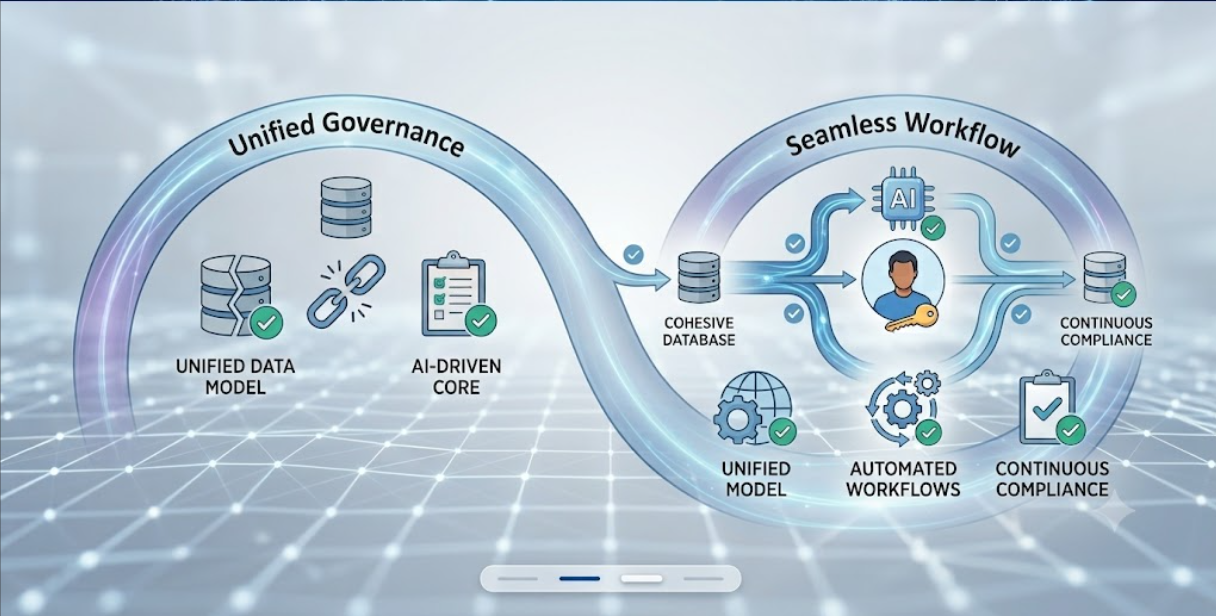
A converged identity platform addresses the root cause rather than the symptoms. Instead of governing each fragment with a separate tool, it unifies identity governance (IGA), access management, privileged access management (PAM), and cloud entitlements (CIEM) on a single data model, so the whole estate is governed from one place.
The resolution is direct, failure mode by failure mode. Siloed directories are resolved by correlating scattered accounts into a single identity record, so the estate is finally visible as connected. Manual provisioning is replaced by automated lifecycle management, which makes deprovisioning immediate and complete rather than dependent on memory. Audit blind spots close because activity across all systems is captured in one model, turning evidence from a reconstruction project into a query. Least privilege becomes enforceable because usage data reveals what access is actually needed, making right-sizing a data exercise rather than a guess. And non-human and AI identities are brought into the same governance model as humans, closing the largest blind spot rather than leaving it to a separate tool.
The shift is architectural. Legacy IAM manages identity in fragments and hopes the fragments add up to a complete picture. A converged platform starts from the complete picture, which is the only foundation on which consistent policy, continuous audit readiness, and genuine least privilege are possible.
Legacy IAM vs. converged identity platform: a capability comparison
| Capability | Legacy IAM | Converged identity platform |
|---|---|---|
| Identity data | Fragmented across siloed directories | Unified on a single data model |
| Provisioning / deprovisioning | Manual, ticket-driven, incomplete | Automated, immediate, complete |
| Privileged access | Governed separately, no full view | Integrated with governance in one system |
| Least privilege | Static roles, over-provisioning by default | Usage-based, continuously right-sized |
| Audit and evidence | Manual correlation across logs | Continuous, generated as the environment runs |
| Cloud and hybrid coverage | Bolt-on tools, fragmented at the seam | Consistent governance across both |
| Non-human and AI identities | Largely unsupported | Governed in the same model as humans |
| Adaptive / Zero Trust support | Weak at the boundary | Consistent context-aware decisions |
The table makes the pattern clear. The difference is not a longer feature list. It is whether identity is governed as one connected system or as a collection of disconnected parts.
Planning your migration from legacy IAM to converged identity
Replacing identity infrastructure is a significant undertaking, because the systems being replaced secure production workloads that cannot go offline. Enterprise migrations from legacy IAM commonly run 12 to 24 months, and the ones that stall usually stall on operational realities such as reviewer fatigue, competing priorities, and leadership turnover, rather than on technology.
A few principles separate migrations that succeed from those that stall. Start with discovery, because you cannot migrate what you cannot see, and most organizations find considerably more identities, especially non-human ones, than they expected. Favor a phased, coexistence-based approach, where the new platform runs alongside the legacy system and applications move over one at a time, rather than a single high-risk cutover. Prioritize standards-based portability, since support for SCIM, OIDC, and SAML lowers both the cost of migrating and the risk of future lock-in. And plan for the operating model, not just the technology, because how access reviews, exceptions, and evidence are actually run is what determines whether the program holds up over time.
The most important principle is that convergence does not have to mean rip-and-replace. A platform that augments the existing identity stack, sitting across current tools and filling the gaps, lets an organization gain unified visibility and begin closing failure modes early, without waiting for a multi-year replacement to complete first.
How ObserveID helps
The gaps in this guide all trace back to the same root cause: identity governed in fragments rather than as one connected system. ObserveID is a converged identity platform that unifies IAM, IGA, PAM, and IVIP across on-premises, hybrid, and multi-cloud environments, governing human, machine, and AI identities together.
Rather than requiring a full rip-and-replace, ObserveID can augment an existing identity stack. It integrates with the tools already in place to create a single view across the estate and closes legacy IAM’s failure modes without a multi-year wait for value. It correlates fragmented accounts into unified identities, automates access reviews and lifecycle management, and applies AI and machine-learning-driven real-time identity risk assessment across the whole environment, including the non-human and AI identities legacy systems cannot see.
The result is not another tool added to the pile. It is the layer that turns a fragmented identity estate into one governed system, which is the foundation every capability in this guide depends on.
See your entire identity estate as one connected system. Book a demo with ObserveID.
Frequently asked questions
1. What security risks does legacy IAM introduce in cloud and hybrid environments?
Legacy IAM cannot extend cleanly into the cloud, so organizations bolt on separate cloud tools and create two silos with a risky seam between them. That seam produces drifting policy sets, an incomplete view of privileged access, weak adaptive controls at the boundary, and ungoverned non-human identities moving between environments. Each gap is a path attackers can use.
2. How does legacy IAM create compliance and audit vulnerabilities?
Because identity activity is scattered across disconnected systems, audit evidence has to be reconstructed manually from separate logs before each cycle. Access reviews often cover only part of the estate, deprovisioning gaps leave active accounts that should be gone, and separation-of-duties conflicts that span systems go undetected. These are among the most common identity-related audit findings.
3. What identities does a converged identity platform manage that legacy IAM misses?
Primarily non-human and AI identities: service accounts, API keys, machine credentials, and AI agents. Legacy IAM was built for human users who log in interactively and has no real model for these, yet they now outnumber human identities in most environments. A converged platform governs them in the same model as human users.
4. What does a phased migration from legacy IAM to a converged identity platform look like?
It begins with discovery to establish what identities actually exist, then runs the new platform alongside the legacy system so applications move over one at a time rather than in a single cutover. Standards-based portability through SCIM, OIDC, and SAML reduces risk, and value arrives throughout the process rather than only at the end. Enterprise migrations commonly run 12 to 24 months.
5. Why is extending legacy IAM more costly than replacing it with a converged identity solution?
Every tool added to a legacy foundation is another silo, another console, and another partial view, so fragmentation and operating cost grow while control does not. Extending legacy IAM keeps paying for integration and maintenance across disconnected systems without ever producing a single view. A converged platform removes that recurring overhead by governing the whole estate from one model.