
The core problem with how most enterprises have built their identity programs is not the tools or the teams, but the fundamental absence of structured context attached to the objects being governed. When your IAM platform doesn’t know that an application is production-facing, PCI-scoped, and serviced by a mix of employees, contractors, and automated processes, it cannot govern that application intelligently. It can only provision and deprovision access, run reviews on a schedule, and hope the certifiers have enough information to make sound decisions.
They usually don’t. That’s not their fault; the information simply isn’t there. Intelligent tagging is the mechanism that puts it there. And for organizations serious about moving from reactive access management to proactive identity security, it’s the architectural foundation worth building on.
How Traditional IAM Ends Up Where It Does
Role-Based Access Control (RBAC) was a sensible architecture for the enterprise of the 1990s. Stable on-premises environments, well-defined job functions, a bounded set of applications, RBAC mapped permissions to roles, assigned roles to users, and that was largely sufficient.
The problem is structural. RBAC has no clean mechanism for handling exceptions, and in modern enterprise environments, exceptions are constant. A user needs access that doesn’t fit an existing role. A contractor needs a subset of permissions that no current role captures exactly. A new SaaS application gets onboarded with entitlement structures that don’t map neatly to any existing role hierarchy.
Each time, the response is the same, i.e., create another role. Do this consistently across hundreds of applications, thousands of users, and a decade of organizational change, and the role catalog becomes something no one fully controls. Enterprise security teams routinely inherit catalogs with tens of thousands of roles, many redundant, some contradictory, and most underdocumented.
Consolidating them is dangerous because the dependencies are unclear. Maintaining them is expensive because there’s no end to the drift. And governing access through them is nearly impossible because they carry no inherent meaning about why access was granted or what risk it represents. This is a role explosion. It’s what happens when a static model collides with a dynamic environment at scale.
When the Governance Model Has No Context
The deeper problem is what role structures fundamentally cannot tell you. A role confirms that a user holds a permission. It says nothing about whether that entitlement is sensitive, the application is in scope for PCI or HIPAA, the environment is production or development, the identity is a full-time employee or a vendor with a contract that ended three months ago, or whether that specific combination of permissions creates a segregation-of-duties violation.
None of that context is structured into the governance model. Which means it has to be reconstructed, manually, by governance teams, during each review cycle, under time pressure, for every entitlement in scope.
This is where the real operational cost of context-free IAM sits. Certifiers are clicking through access reviews without enough information to make meaningful decisions. Audit preparation teams spend weeks mapping applications to regulatory frameworks before any actual governance work begins. Identity analysts manually cross-reference entitlement data against environment configurations to flag overprovisioning. Security teams investigated after-the-fact because there was no automated detection to catch the risk while it was accumulating.
That labor is the tax on operating an identity program without a structured context. Intelligent tagging eliminates most of it, not by adding a feature, but by changing what the platform fundamentally knows about every object it manages.
Traditional RBAC vs. Intelligent Tag-Based Governance
| Dimension | Traditional RBAC | Intelligent Tag-Based Governance |
| Policy Scope | Defined per-role or per-application individually | Written at the tag level, one policy inherits across all matching objects |
| Context awareness | Binary: does the user have the permission or not? | Rich metadata: sensitivity, environment, regulatory scope, identity type |
| Scalability | Degrades as environments grow (role explosion) | Scales with the environment, new objects inherit existing policies at tagging |
| Compliance mapping | Manual, rebuilt for each application per audit cycle | Automatic through tag inheritance at application onboarding |
| NHI governance | Minimal, designed around human employee lifecycles | Native, dedicated tag taxonomy for machine identities, bots, and AI agents |
| Posture management | Periodic, tied to review cycle cadence | Continuous, tag-driven alerts fire when posture drifts between cycles |
| AI/automation readiness | No structured context for models to reason over | Tag metadata feeds AI models and drives automation directly |
| Cross-environment governance | Fragmented by the infrastructure layer | Environment-agnostic, the tag travels with the object, not the platform |
What are Intelligent IAM Tags?
“Tagging” gets thrown around in IAM marketing loosely enough that it’s worth being precise about what it means in a governance context.
A tag that functions as a display label, something a human analyst can filter on in a dashboard, is a UX feature. Useful, but not governance. A tag that the platform can reason over, enforce policy from, feed into risk scoring, and act on without human intervention is something architecturally different: a governance primitive.
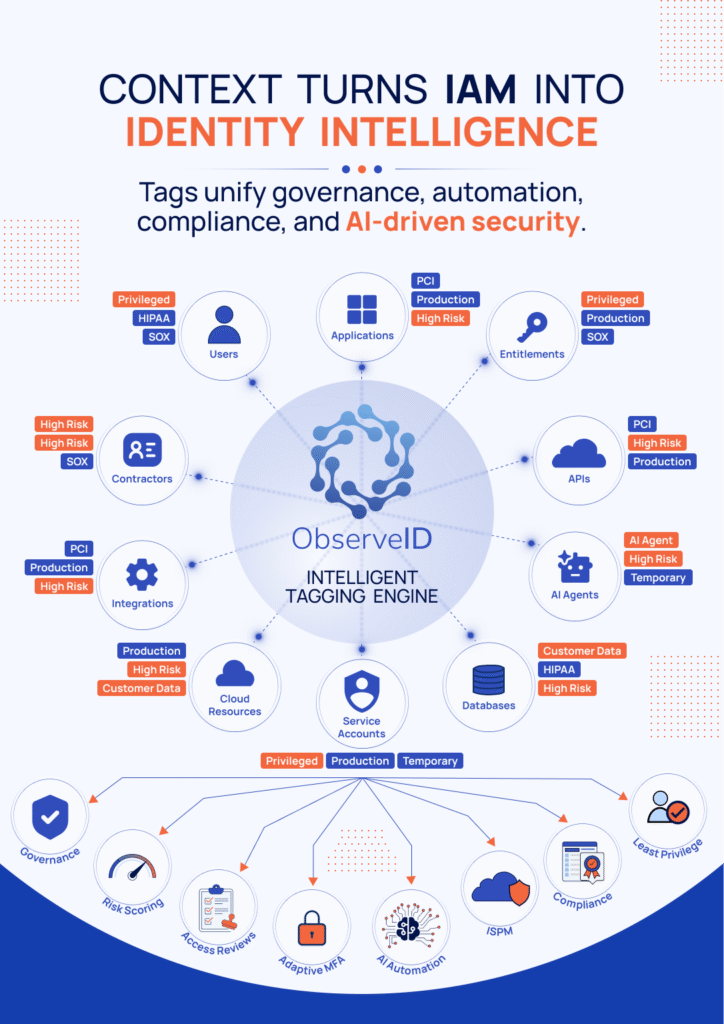
When an application is tagged PCI, that tag should automatically trigger a defined governance posture across every component of the IAM platform. Quarterly certification requirements. SoD policy enforcement. Mandatory MFA for all identities with access. Elevated risk scoring on any access request. Evidence collection configured for audit readiness. The tag is an instruction, not to a human, but to the governance engine itself.
Tags are also composable. An entitlement tagged Privileged + Production + PCI carries more governance signals than any single attribute. A platform that reasons over tag combinations can govern that entitlement correctly without anyone writing a bespoke policy for it. The policy was written once, at the tag level, and the entitlement inherited it at classification. That’s the architectural shift.
In a complete intelligent tagging model, metadata applies across every class of identity object:
Applications and entitlements: Tags here drive review requirements, risk classification, and access policies for the bulk of provisioning activity in any organization. This is also the fastest path to compliance policy automation.
Identities: human users, including employees, contractors, and third-party vendors, need contextual tags that change what governance rules apply. A contractor with system access being tagged Contractor is about ensuring auto-expiration triggers when the contract ends, access stays scoped to approved applications, and privileged access never gets granted standing.
Non-human identities: service accounts, APIs, RPA bots, and AI agents, require a separate tag taxonomy because they have no HR record, no manager, and no natural lifecycle event. Tags like Machine Identity, AI Agent, Production API, and Privileged Service Account are what create the classification infrastructure needed to govern them differently from human users.
Roles: They need tags, particularly privileged roles that warrant elevated scrutiny regardless of who currently holds them. A role tagged High Risk should trigger enhanced certification requirements independent of the individual assigned to it.
Resources and cloud assets: databases, storage buckets, Kubernetes namespaces, and cloud workloads benefit from tags that communicate sensitivity and environment context to the governance layer. An untagged production database is an invisible risk. A database tagged Production + Customer Data + SOX Scoped is a governed one.
Integrations and third-party connections: These are perhaps the most underaddressed category. Third-party APIs and SaaS integrations often have access to sensitive systems entirely outside standard approval workflows. Without tags, those connections are invisible to the governance model.
Six Ways ObserveID Uses Tagging as a Governance Differentiator
1. Dynamic Access Governance at the Policy Level
Traditional governance requires policy configurations to be created and maintained per application, per role category, and per entitlement. At enterprise scale, this means thousands of individual configurations, each needing to be built correctly, kept current, and updated every time something in the environment changes.
ObserveID’s tag-driven approach collapses that complexity. Policies are written once, at the tag level, and every object matching those tags automatically inherits the associated governance posture.
Any entitlement carrying Privileged + Production + PCI picks up the full governance stack: mandatory MFA before access is granted, approval workflow through a defined chain, quarterly access certification with manager sign-off, session monitoring during privileged access windows, and elevated risk scoring on any subsequent access request. New applications onboarded with those tags inherit the posture immediately. New entitlements inherit it from the parent application classification. Governance coverage scales with the environment.
The operational implication is significant. Instead of an IAM team spending weeks configuring governance for every new application, they spend that time on classification, tagging the application correctly, and the governance follows automatically.
2. Continuous Identity Security Posture Management (ISPM)
ISPM as a discipline rests on a straightforward reality: access risk accumulates continuously. Provisioning decisions pile up. Roles drift from their original scope. Applications get onboarded faster than governance teams can configure controls. Permissions granted for a specific project persist long after the project ends. And organizational restructuring creates mismatches between what an identity needs and what it has.
Periodic access reviews catch some of this, the risk that existed at the moment the snapshot was taken. They don’t catch what accumulated in the weeks or months between review cycles. In environments that change daily, that window is where most of the meaningful exposure sits.
With tags providing structured context across the full identity ecosystem, ObserveID maintains a live, continuously updated picture of identity posture. It can answer questions that traditional IAM platforms require manual investigation to address:
- Which identities have access to applications tagged Sensitive Infrastructure, and when were those access grants last certified?
- Which AI agents in this environment have entitlements touching resources tagged Customer Data?
- Which contractor accounts hold Privileged + Production access with no defined expiration date?
- Which integrations are reaching SOX Scoped applications outside any approved automation workflow?
These aren’t questions answered on a quarterly schedule. They’re monitored continuously, and posture drift triggers automated responses, not a ticket that waits for the next sprint.
3. AI-Driven Governance Automation via OBI
ObserveID’s Observational Behavioral Intelligence (OBI) framework is built to make governance proactive. The prerequisite for AI to do anything useful with identity data is structured context; without it, machine learning applied to entitlement catalogs is pattern-matching against noise. Intelligent tagging is what gives OBI’s models the signal quality they need to produce actionable results.
With tag-enriched data feeding OBI, the platform can operationalize decisions that would otherwise require significant analyst time:
- Toxic combination detection: Automatically flagging any identity holding SOX Approval and SOX Journal Entry simultaneously, before that violation surfaces in an audit finding rather than an automated alert.
- Dormant high-risk access: Surfacing accounts tagged Critical Infrastructure with no access activity in the past 90 days, prioritized for immediate review rather than buried in the next certification cycle.
- Least-privilege cleanup at scale: Generating cleanup recommendations targeted at entitlements where tag-based risk scoring is high, and usage data shows the access isn’t being exercised. Prioritized queue, not a spreadsheet.
- Adaptive approvals: Triggering enhanced approval workflows when access context changes: a user gets reclassified to a contractor relationship, an application gets elevated to production, a role gets tagged High Risk following a security assessment.
- Auto-expiration of temporary access: closing Temporary Access tagged entitlements when the defined window lapses, without waiting for a human to initiate offboarding.
This is the difference between an AI layer that surfaces observations and one that drives operational decisions. Tags make that distinction possible.
4. Compliance That Follows the Tag, Not the Calendar
Regulatory compliance mapping is genuinely painful, and most of that pain happens before any actual review work begins. Determining which applications fall under which frameworks, configuring review schedules, setting up evidence collection, and verifying SoD policies are enforced for in-scope systems. In organizations running under HIPAA alongside SOX, or PCI alongside GDPR, that preparatory work compounds into months of labor per cycle.
Tags change this through policy inheritance. An application tagged HIPAA at onboarding inherits its review cadence, evidence collection configuration, audit workflow, and certification schedules directly from the HIPAA policy definition. Tag it SOX Scoped as well, and it inherits both. When regulatory scope expands, a new system comes into PCI scope after a product change, for example, a tag update propagates the appropriate governance posture automatically to that system and everything that connects to it.
For security and compliance teams that treat audit preparation as a distinct operational phase running two to three months before an examination, this changes the operating model. Compliance becomes a continuous state rather than a periodic event.
5. Non-Human Identity Governance in the Agentic AI Era
Non-human identities are the fastest-growing and most underaddressed risk in modern enterprise environments. Service accounts sit with broad, standing privileges and no certification history because they have no manager and no HR record. APIs have access paths that nobody on the current security team fully understands, they were set up years ago and never reviewed. RPA bots frequently hold privileges far beyond what their actual function requires. And AI agents, increasingly embedded in enterprise workflows, are accessing sensitive systems, reading and writing customer records, and calling downstream APIs with minimal monitoring attached.
The scale warrants serious attention. In cloud-heavy environments, non-human identities routinely outnumber human users by a significant margin. They carry real access. They represent real exposure. And traditional IAM governance, built around the human employee lifecycle, hire, change role, terminate, has no natural equivalent for a service account or an AI agent.
ObserveID’s tag-based NHI governance model addresses this directly. Tags like Machine Identity, AI Agent, Production API, and Privileged Service Account give the platform the classification it needs to apply governance rules that are appropriate to non-human access patterns: isolated machine privileges rather than shared credentials, behavioral anomaly detection calibrated to expected automation behavior (not human usage norms), AI agent access path tracking across the full environment, and standing privilege reduction through targeted expiration policies.
As AI systems become standard infrastructure in enterprise operations, governing their access with the same rigor as human identities is not a future state to plan toward. It’s a current security requirement.
6. One Governance Layer Across the Entire Hybrid Estate
Enterprise environments are fragmented by design and by history. Cloud platforms, SaaS applications, on-premises systems, legacy infrastructure, containerized workloads, databases, and API gateways all coexist. Each layer has its own access model, and many have their own point solution for access management. The result is governance fragmentation along infrastructure lines: a policy enforced in AWS doesn’t automatically carry over to a legacy on-premises application. Compliance controls built for the core ERP system don’t extend to the SaaS tools adopted by individual business units.
Because ObserveID’s tags are environment-agnostic, they describe governance intent, not infrastructure location; the platform applies consistent governance policies across the entire hybrid estate. An entitlement tagged Production + Privileged carries identical governance requirements whether it lives in a cloud provider, a SaaS platform from 2022, or an on-premises system from 2008. The infrastructure boundary becomes irrelevant to the policy engine.
For organizations where fragmented governance has been a persistent problem, where “we have different tools for cloud and on-prem” is the explanation for coverage gaps, this is a structural improvement, not an incremental one.
ObserveID is built on tag-driven governance from the ground up. Not a feature added to a provisioning workflow, but the foundational layer that drives dynamic policy, continuous ISPM, OBI-powered automation, and compliance posture across cloud, SaaS, on-premises, and every non-human identity in between.
Book a Demo with ObserveID for a quick walk-through of how tag-based governance applies to your specific environment, your identity types, and your compliance requirements
IAM Tag Reference: Governance Behaviors Triggered in ObserveID
| Tag | Applied to | Governance behavior |
| PCI | Applications, entitlements | Quarterly certification, SoD enforcement, session monitoring, and elevated risk score |
| HIPAA | Applications, resources | HIPAA-specific review cadence, evidence collection, and workforce-only access restriction |
| SOX Scoped | Applications, roles | Dual-control certification, SoD conflict detection, and change control integration |
| Privileged | Entitlements, roles, service accounts | MFA enforcement, approval chain required, JIT access consideration, session recording |
| High risk | Entitlements | Peer review on all requests, auto-prioritized in OBI cleanup queue |
| AI agent | Non-human identities | Access path tracking, behavioral monitoring, privilege isolation, no standing access |
| NHI | Service accounts, APIs, bots | Separate governance lifecycle, no manager certification, dedicated anomaly detection |
| Contractor | Identities | Auto-expiration at contract end date, scoped to approved applications only |
| Temporary access | Entitlements | Hard expiration on defined date, no renewal without re-approval workflow |
| Production | Applications, environments | Restricted provisioning windows, change control integration, and elevated review frequency |
| Customer data | Applications, resources | Mandatory logging, privacy compliance scope inclusion, restricted access classification |
What Changes When You Build Governance on Metadata
Traditional identity governance is organized around a single question: who has access? That question is necessary but not sufficient.
Knowing that an identity holds a permission says nothing about whether that permission is sensitive, whether it creates a regulatory obligation, whether the identity is still appropriate to hold it, whether the combination of permissions that identity holds creates a SoD violation, or whether anyone is monitoring what that identity does with the access.
Modern identity security needs a more specific question: which high-risk identities have sensitive access under what conditions, and is that access still justified right now?
Answering that at enterprise scale, continuously, across both human and non-human identities, across hybrid environments that don’t share a common access model, while satisfying multiple overlapping regulatory frameworks simultaneously, that’s the governance problem intelligent tagging makes tractable.
Tags become the connective tissue across the identity ecosystem. They make context persistent, machine-readable, and actionable without requiring human reconstruction at every review cycle. They allow policy to be declarative rather than procedural. They let posture management be continuous rather than periodic. They give AI models the structured signal needed to make governance recommendations that security teams can actually act on.
For ObserveID, intelligent tagging is the architectural decision that determines what the rest of the governance platform can accomplish, the difference between an IAM platform that manages access and one that understands it.
Frequently Asked Questions (FAQs)
1. What is intelligent tagging in IAM, and how is it different from regular labeling?
Regular labeling is metadata for human consumption; it helps analysts filter views and read dashboards more easily. Intelligent tagging is metadata for machine consumption: structured attributes that the IAM platform itself reads, enforces policy from, and acts on automatically. When an application is tagged as PCI in ObserveID, the platform automatically configures the associated review cadence, SoD policies, MFA requirements, and evidence collection, without requiring a human to configure each component separately. The tag is an instruction, not an annotation.
2. Why does intelligent tagging matter if we already have roles and groups defined?
Roles and groups define what access exists. They don’t carry any context about why that access is sensitive, what environment it applies to, what regulatory frameworks cover it, or what kind of identity holds it. That context is what governance decisions depend on. Without it, certifiers review access with insufficient information to make sound decisions, compliance teams manually reconstruct the scope before every audit, and risk-based prioritization is largely guesswork. Tags attach that context persistently to the data, making it available to the platform and everyone who uses it.
3. What is ISPM, and why does metadata tagging matter for it?
Identity Security Posture Management (ISPM) is the practice of continuously assessing and managing the security state of your identity layer, not just reviewing it on a quarterly schedule. Continuous posture management requires the ability to programmatically answer questions like “which privileged identities have no MFA requirement?” or “which contractor accounts still have production access?” Those questions require structured metadata. Without tags providing that context persistently, answers depend on manual investigation. With tags, ObserveID monitors those conditions in real time and surfaces drift the moment it occurs.
4. How does ObserveID govern non-human identities using tags?
NHIs, service accounts, APIs, RPA bots, and AI agents don’t fit the human employee lifecycle model that traditional IAM governance was built around. There’s no onboarding event, no manager, no termination workflow. ObserveID uses dedicated tags like AI Agent, Machine Identity, Production API, and Privileged Service Account to classify NHIs and apply governance rules specific to non-human access patterns: behavioral anomaly detection calibrated to automation behavior (not human usage norms), access path tracking, privilege isolation, no standing access by design, and expiration policies that don’t require a manager certification. The governance is appropriate to what these identities actually are.
5. How does tagging reduce compliance overhead for frameworks like PCI DSS, SOX, and HIPAA?
Most compliance preparation work in enterprise IAM is reconstruction: figuring out which systems were in scope, verifying that access reviews ran on the right cadence, and pulling evidence of SoD enforcement. This happens because compliance posture isn’t maintained continuously; it’s assembled at audit time. Tags change this through policy inheritance. When an application is tagged SOX Scoped at onboarding, it automatically picks up review cadence, SoD enforcement, evidence collection, and certification requirements from the SOX policy definition. The evidence exists continuously. When the audit comes, you generate a report; you don’t spend weeks rebuilding one.
6. Does tag-based governance work across hybrid environments, cloud, SaaS, and on-premises?
Yes, and this is one of its most practical advantages. Tags describe governance intent, not infrastructure location. An entitlement tagged Production + Privileged carries the same governance requirements whether it lives in a cloud provider, a SaaS application, or an on-premises system. ObserveID applies a consistent policy across the full hybrid estate using tags as the common layer, which means security teams manage one governance posture across all infrastructure rather than maintaining separate approaches for each environment.