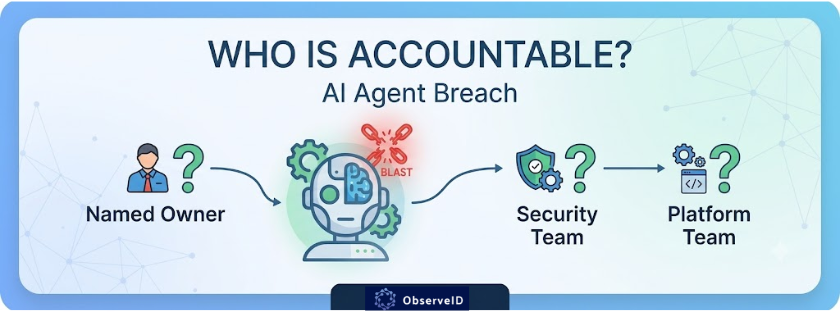
When an employee causes a breach, accountability follows lines everyone understands. There is a person, a manager, an access record, and a process. When an AI agent causes one, most organizations discover that none of those lines exist. The agent has no manager. Its access was granted by a script. Three teams touched its deployment and none of them owns it.
The short answer to the title question: legally, your organization is accountable, and courts have already said so. Internally, accountability belongs to whoever you named in advance, and most companies have named no one. This article covers both answers and how to close the gap between them.
What is AI agent accountability in identity security?
AI agent accountability is the ability to trace every action an agent takes back to a responsible human, and to prove that the controls governing that agent actually operated. In identity security terms, it rests on four things: each agent holds a unique identity with a named human owner, every action is logged with its delegation chain, high-impact actions carry approval records, and the evidence of all of this is generated continuously rather than reconstructed after an incident.
This is a different discipline from AI governance in the broad sense. Model risk, bias, and acceptable use are policy questions. Accountability is an identity and records question: who owns this agent, who authorized this action, and can you prove it. When a breach happens, those are the questions regulators, courts, and your own executives ask first, and they are answerable only if the records already exist.
The accountability gap: Why autonomous AI agents create new liability risks
Traditional software does what it was configured to do, so accountability for its behavior maps cleanly to whoever configured it. Agents break that mapping in three ways.
They act autonomously: An agent decides at runtime which tools to invoke and which data to touch. It can take actions nobody specifically instructed, which means “who told it to do that” often has no answer.
They delegate: Agents spawn sub-agents and act on behalf of users. When an action traces to a credential shared by four agents serving forty users, the delegation chain either was recorded at the time or cannot be reconstructed at all.
They multiply faster than ownership does: Gartner projects that 40% of enterprise applications will embed AI agents by the end of 2026, while fewer than 1% of organizations have reached full maturity in governing them. Asked who is actually answerable for agent behavior, only 7.2% of organizations in Gravitee’s April 2026 survey could point to a named individual.
The result is a specific kind of exposure. You are deploying autonomous actors with real credentials into production, liability for their actions is strict and external, and in all likelihood nobody inside the organization has been assigned to carry it. That is the accountability gap, and it does not show up on any dashboard until the day it becomes an incident report.
How liability is distributed across vendors, deployers, and users
Courts settled the core question faster than most companies expected. In Moffatt v. Air Canada, the airline’s chatbot invented a bereavement fare policy, a customer relied on it, and Air Canada argued that the chatbot was a separate legal entity responsible for its own actions. The tribunal called that “a remarkable submission” and held the airline responsible for all information its systems provide. US law reaches the same destination through existing doctrine: UETA Section 14 and agency law bind the deployer when an automated agent acts.
This holds even when the agent does something nobody intended. In March 2026, GitHub Copilot began inserting promotional tips into pull request comments, reaching roughly 1.5 million PRs before the feature was withdrawn. No human had approved the behavior. It was still GitHub’s problem to own publicly. When your agent freelances, you own the freelancing.
Here is how responsibility actually divides among the parties involved.
| Party | Responsible for | Not responsible for |
|---|---|---|
| AI platform vendor | Security of the platform itself: model integrity, infrastructure, disclosed vulnerabilities | What your agent accesses, what it does with that access, who reviews it |
| Deployer (your organization) | Everything the agent does in your environment: its access, its actions, its oversight, and all harm to customers, partners, and regulators | Platform-level flaws, though you answer externally first and pursue the vendor under contract afterward |
| End user invoking the agent | Using the agent within your policies | The agent’s autonomous behavior; users are rarely liable for what the agent did on their behalf |
The pattern to internalize sits in the deployer row. Vendor contracts can shift costs between businesses after the fact. They cannot shift liability toward the customers and regulators your agent harmed. “Our vendor’s model did it” is not a defense. It is an invoice dispute you get to have later.
Building an AI agent governance framework for breach prevention
Accountability that works under pressure is built from four links, each answering a specific question an investigator will ask.
| Link | What it means in practice | The question it answers |
|---|---|---|
| Ownership | Every agent registered with a named human owner | Who do we call about this agent, right now? |
| Attribution | Every action logged with its full delegation chain | Who is answerable for this specific action? |
| Authorization | Irreversible or high-impact actions require pre-execution approval, and the approval is recorded | Who decided the agent could do this? |
| Evidence | Access records, behavioral logs, and approvals generated continuously as the system runs | Can we prove our controls operated? |
None of these links is a policy statement. Each is a record that either exists on the day of the breach or does not. Ownership is the cheapest link and the most neglected: assigning a named owner to every agent costs nothing and immediately gives every future incident a first responder.
The framework also pays for itself before any breach. Enterprise customers now ask about agent controls in vendor security reviews, and being able to answer with an inventory, ownership records, and action logs rather than a policy PDF is starting to decide shortlists in regulated industries. Internally, clear ownership removes the hesitation that stalls agent adoption. Teams deploy faster when saying yes does not mean absorbing an unowned risk. Accountability is not the brake on agent programs. It is what makes speed survivable.
Documentation and audit trail requirements for AI agent oversight
When an incident happens, four categories of documentation determine whether you are explaining a contained event or defending a negligence claim.
1. Agent inventory: A current record of every agent in the environment, its purpose, its owner, and its granted access. This must include agents deployed outside formal review, which means it requires continuous discovery, not a registration form that teams may or may not fill in.
2. Action logs with delegation context: What each agent did, when, on whose behalf, and through which chain of delegation. Logs that record the action but not the chain answer the easy question and fail the hard one.
3. Approval records: For every high-impact action, evidence of who authorized it and when is bound to the action itself rather than filed in a separate system.
4. Behavioral baselines and deviations: A record of what normal looked like for each agent and when its behavior departed from it. This is what demonstrates your oversight was active rather than nominal, and it is also what shortens the incident, since drift detected early is containment rather than forensics.
The common failure is not missing any single category. It is holding fragments of each across six systems that were never designed to answer an investigator’s questions together.
What are the Compliance obligations for AI agent deployments
The regulatory picture hardened substantially through 2026, and it converges on the same records described above.
The EU AI Act’s high-risk obligations are now in full effect, with penalties reaching €35 million or 7% of global revenue. Its Article 14 requires that a human be able to interpret, intervene in, stop, or override high-risk AI systems, which presumes you know what your agents are doing in the first place.
The sharper instrument for breach scenarios is the EU’s revised Product Liability Directive, which brings AI systems into strict liability with a presumption of causality. If you cannot demonstrate that your system followed documented safety protocols, a court can presume your system caused the harm. The burden of proof has moved to the deployer, and it is a burden of records.
Sector regulators are moving in parallel. FINRA’s 2026 Regulatory Oversight Report names agent scope creep as a specific risk for financial firms, and SOC 2 and GDPR audits now routinely ask how agent access is provisioned, reviewed, and revoked. The direction across all of it is consistent: documented, continuous, provable oversight of agent identity and behavior is becoming the compliance baseline, not the gold standard.
Protect your organization with ObserveID’s AI identity security framework
As AI agents become more embedded in enterprise workflows, having visibility into what they’re doing and who is responsible for them becomes increasingly important. ObserveID helps organizations build that visibility by bringing AI agents into their identity ecosystem, making it easier to understand ownership, monitor activity, and support governance efforts.
Book a demo with ObserveID.
Frequently asked questions
1. Can AI agents operating within identity systems comply with regulations like GDPR or HIPAA?
Yes, but compliance depends on the deployer, not the agent. GDPR and HIPAA obligations attach to the organization processing the data, so an agent touching personal or health information must operate under the same controls as any other identity: documented purpose, minimum necessary access, audit logging of every access event, and the ability to demonstrate those controls to an auditor. The practical requirements are a unique identity per agent, scoped rather than broad data access, and continuous logs of what the agent actually touched. An agent running on a shared credential with standing access to a full data store is very difficult to defend under either regulation.
2. What should organizations look for in an AI agent platform to minimize breach liability?
Look for the capabilities that produce accountability records automatically. That means unique identity per agent rather than shared credentials, support for short-lived and task-scoped tokens instead of standing access, delegation tracking that links every action back to a responsible human, pre-execution approval workflows for high-impact actions, and continuous behavioral logging. Also examine the shared responsibility line in the contract: the vendor should state clearly what platform security it owns, because everything else, including the agent’s access and behavior in your environment, remains yours. A platform that cannot tell you what an agent did last Tuesday will not protect you when a regulator asks.
3. What governance frameworks exist for managing AI agent accountability in identity security?
Several are converging on the same requirements. The NIST AI Risk Management Framework, extended by agentic AI profiles, covers autonomy tiers and human oversight. The EU AI Act’s Article 14 mandates human ability to intervene, stop, or override high-risk systems. OWASP’s guidance on excessive agency addresses over-permissioned agents directly, and sector regulators such as FINRA have named agent scope creep as a supervisory concern. In practice, most organizations implement these through an identity-centric model: an owned inventory of agents, per-action privilege tiers, recorded delegation, and continuous behavioral monitoring, which together satisfy the documentation expectations that all of these frameworks share.
4. How are autonomous AI agents different from traditional automation tools?
Traditional automation executes a fixed script: the same task, the same way, every run, using permissions defined once. An autonomous agent reasons toward a goal, decides at runtime which tools to invoke and which data to access, can spawn sub-agents, and may act in ways nobody specifically instructed. That difference is what breaks conventional accountability. A script’s behavior maps cleanly to whoever wrote it, while an agent’s behavior can only be attributed if its identity, delegation chain, and approvals were recorded as it acted. It is also why agents need behavioral monitoring rather than static rules: their normal activity varies by task, so misuse is detected by deviation from a learned baseline, not by a threshold set in advance.
5. Who is legally responsible when an AI agent causes a data breach?
The organization that deployed the agent. Courts and tribunals have rejected the argument that an AI agent is a separate legal entity, most visibly in Moffatt v. Air Canada, and existing agency law attributes an automated agent’s actions to its deployer. Vendor contracts can allocate costs between the deployer and the platform provider after the fact, but they cannot shift liability toward the customers or regulators the breach harmed. Under the EU’s revised Product Liability Directive, the deployer also carries the burden of proving its controls operated, which makes documented oversight a legal necessity rather than a best practice.