
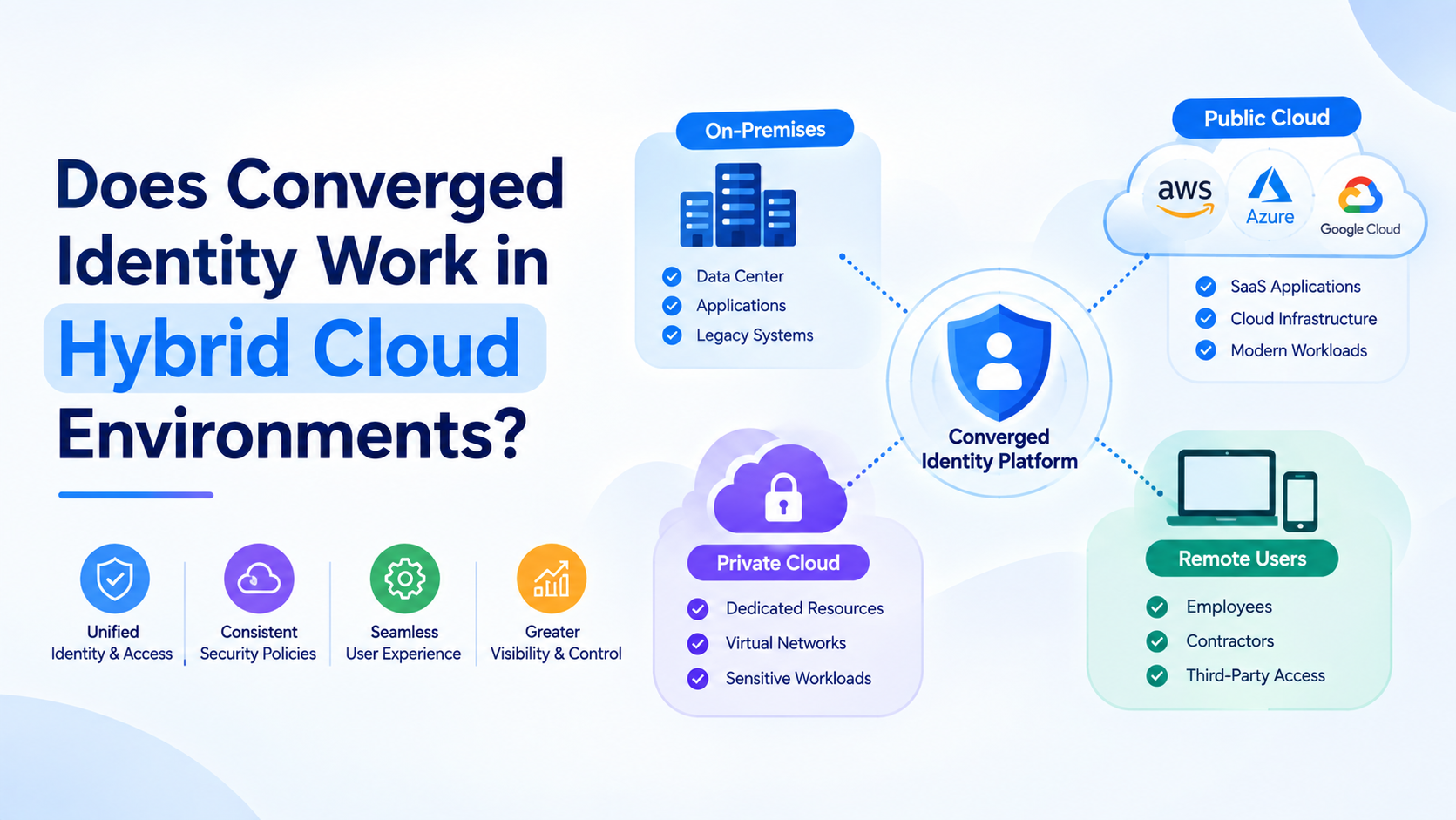
It’s a fair question to be skeptical about. Converged identity gets pitched as one platform that finally brings order to your identity chaos, but anyone who has actually run identity across on-prem and cloud knows the chaos is stubborn. You have an Active Directory that predates half your staff, identities scattered across three cloud providers that each define permissions differently, service accounts nobody fully tracks, and a compliance team that needs a single clean answer across all of it.
So does convergence actually hold up here, or does hybrid break it like it breaks everything else? The short version: it works, but only to the extent the platform is genuinely built to reach both worlds, and a lot of what people blame on convergence is really the friction of hybrid itself, which no tool escapes. The useful conversation isn’t whether convergence is perfect. It’s whether it handles hybrid better than the fragmented stack you’re running now, and where it still has limits worth knowing before you commit.
This blog is for the security architects and infrastructure strategists who live in these environments, and the GRC teams who have to prove they’re under control. It defines what converged identity means in a hybrid context, lays out the specific problems hybrid creates, shows where convergence genuinely resolves them and where it doesn’t, and gives compliance teams the audit-relevant language to make the case internally.
What is converged identity security in a hybrid context?
Converged identity security is the delivery of historically separate identity disciplines, identity governance and administration (IGA), privileged access management (PAM), and access management, through a single platform built on one data model and one policy engine. In a hybrid context, “converged” carries a second, harder requirement: that single model has to span on-premises and cloud infrastructure consistently, applying the same governance, the same policy, and the same visibility to an identity whether it authenticates against a legacy on-prem application or a modern SaaS platform.
That second requirement is where many platforms marketed as converged fall short. A cloud-native platform that governs SaaS beautifully but cannot reach a legacy on-prem application is not converged for a hybrid enterprise; it is a cloud identity tool with a gap. Genuine hybrid convergence means one control plane over both worlds, not two systems reporting into a shared dashboard.
The distinction matters because the entire value of convergence in a hybrid environment rests on it. The point of consolidating is to get one answer to “who can access what, across everything.” If the platform cannot see everything, the single view it promises is incomplete exactly where hybrid environments are most exposed: at the seam between old and new infrastructure.
Why hybrid cloud environments challenge traditional identity management
Before showing how convergence helps, it is worth being specific about what goes wrong. These are the failure modes hybrid creates, and they are real regardless of tooling.
1. Identity sprawl across disconnected systems: The same person exists as an Active Directory account, an Entra ID identity, an IAM user in AWS, and a handful of SaaS logins, often with no authoritative link between them. Nobody can say with confidence how many identities a single human actually has, let alone a single service.
2. Inconsistent policy enforcement: A policy defined for cloud resources does not automatically apply to on-premises systems, and vice versa. Teams end up maintaining two or more sets of policies that are supposed to express the same intent and inevitably drift apart. The gap between them is where inappropriate access survives.
3. Split PAM and IGA controls: Privileged access is frequently governed by one tool on-premises and another in the cloud, and standing governance by yet another. An administrator’s full privilege footprint is never visible in one place, so the highest-risk access in the environment is also the least completely understood.
4. Fragmented visibility and audit trails: When identity activity is logged in separate systems with different schemas, reconstructing what an identity did across the hybrid boundary becomes a manual correlation project. For an incident responder, that delay is time the attacker keeps using the access. For an auditor, it is evidence that has to be assembled by hand.
5. Adaptive security gaps at the boundary: Context-aware access decisions depend on signals, device posture, location, risk score. When those signals live in different systems on each side of the boundary, adaptive policy weakens exactly where identities cross between environments, which is where attackers most want to move.
| Hybrid challenge | Practical consequence |
|---|---|
| Identity sprawl | No authoritative count of identities per human or workload |
| Inconsistent policy | Duplicated policy sets that drift; access gaps at the seam |
| Split PAM/IGA | No single view of an identity’s full privilege footprint |
| Fragmented audit trails | Cross-boundary activity reconstructed manually |
| Boundary adaptive gaps | Weak context-aware control exactly where identities cross |
None of these is hypothetical. They are the day-to-day reality of running identity across mixed infrastructure, and they are the reason “just add another tool” has made many environments worse rather than better.
How converged identity platforms handle hybrid infrastructure
A converged platform addresses these problems by doing one thing the fragmented stack cannot: bringing identity data from both worlds into a single model before trying to govern it. How well a given platform does this is the real evaluation question, but the mechanism is consistent across genuine implementations.
1. A unified identity fabric across environments. The platform connects to on-premises directories and applications and to cloud IAM and SaaS, then correlates the scattered accounts into a single identity record. The Active Directory account, the Entra identity, and the AWS IAM user resolve to one person or one workload. This is the prerequisite for everything else; you cannot enforce consistent policy on identities you cannot see as connected.
2. Connector breadth is the make-or-break detail. In hybrid environments, a platform is only as converged as the systems it can actually reach. Modern SaaS is easy; the hard part is the legacy on-prem application with no modern API and the mainframe that still runs a core process. Evaluate connector coverage against your specific legacy systems, and confirm the platform has a path, API, standards-based provisioning, direct database connection, or robotic automation for the systems that do not cooperate. This single factor separates platforms that are converged in theory from ones converged for your environment.
3. One policy engine across both worlds. With identities in a single model, a policy is defined once and enforced consistently whether the resource is on-premises or in the cloud. This removes the drift between duplicated policy sets, which is one of the largest sources of hybrid access risk.
4. Unified privileged access and governance. Convergence brings privileged access and standing governance into the same system, so an identity’s full footprint, standing entitlements, and privileged activity, on-prem and cloud, is visible together. Toxic combinations that span the boundary become detectable because the data is no longer split.
Consistent adaptive access at the boundary. When context signals feed one decision engine, adaptive and continuous verification apply the same way across environments, closing the boundary gap that fragmented tools leave open. This is the foundation any credible Zero Trust implementation in a hybrid environment depends on.
The honest caveat is that it all holds only to the degree the platform genuinely reaches your infrastructure and genuinely uses one model underneath. The next two sections cover where that gets tested hardest.
Endpoint security and API security across hybrid boundaries
Two boundary surfaces deserve specific attention, because they are where hybrid identity is most often compromised.
1. Endpoints: In a hybrid environment, the same identity signs in from a managed corporate laptop, a personal device, and a cloud workstation, and the risk of each is different. Converged identity improves endpoint posture by folding device context into the access decision consistently; a login that is acceptable from a compliant managed device is treated differently from the same login on an unmanaged one, regardless of which side of the hybrid boundary the target resource sits on. The value is consistency: the same device-aware logic everywhere, rather than strong device checks in the cloud and weak ones on-prem.
2. APIs and machine-to-machine access. This is the surface most under-governed in hybrid environments and the one growing fastest. On-prem applications call cloud services, cloud workloads call back into on-prem systems, and each of those calls authenticates with a credential, an API key, a token, a service account, increasingly an AI agent’s identity. These non-human identities dominate hybrid environments numerically and are routinely the least monitored. A converged platform that governs non-human identities in the same model as human ones can see these machine-to-machine paths across the boundary, apply lifecycle and least-privilege controls to them, and detect when one behaves abnormally. A platform that only governs workforce users leaves the majority of the hybrid attack surface unwatched.
When you evaluate a converged platform for a hybrid environment, test it against your non-human and API identities specifically, not just your employees. That is where the hardest hybrid risk lives, and where the difference between platforms is largest.
Meeting compliance mandates in distributed identity environments
For regulated industries, the compliance question is often the one that actually decides the platform, and hybrid infrastructure makes it harder in a specific way: auditors do not care that your identity data is split across systems. They ask a single question — who has access to this regulated resource, how did they get it, and is it appropriate, and expect one coherent answer regardless of where the resource or the identity lives.
A converged platform helps here structurally, not just operationally. Because identity activity across on-prem and cloud is captured in one system with a consistent model, the evidence auditors ask for is generated continuously as the environment runs, rather than reconstructed from separate logs before each audit. This changes the compliance posture from periodic scramble to standing readiness.
The audit-relevant capabilities that matter across frameworks:
- A single access review that spans hybrid infrastructure. Certifications cover on-prem and cloud access together, so a review is not silently missing half the estate. Access reviews limited to one environment are a common audit finding.
- Complete, correlated audit trails. Who accessed what, across both worlds, tied to a resolved identity rather than scattered account records.
- Consistent separation-of-duties enforcement. Toxic entitlement combinations are detectable even when the conflicting permissions live in different environments.
- Evidence for non-human identities. Ownership, access, and activity records for the service accounts and machine identities that regulated frameworks increasingly require be governed, not only human users.
The framework mapping is consistent: SOX, HIPAA, PCI DSS, and SOC 2 all attach their obligations to access rather than to where the infrastructure sits. A converged platform that spans the hybrid boundary lets a GRC team answer each framework’s access questions once, with evidence, instead of assembling a different partial answer from each system.
Evaluate converged identity for your hybrid cloud architecture
Converged identity does work in hybrid environments, but the caveat throughout this guide is the whole point. It works to the degree the platform genuinely reaches both your worlds and genuinely governs them from one model. A platform that only truly covers the cloud will leave your legacy exposure exactly where it already is.
So the evaluation comes down to a few direct tests. Does it connect to your specific legacy and on-prem systems, including the awkward ones without modern APIs? Does it govern non-human and API identities across the boundary, not just workforce users? Does it enforce one policy consistently in both environments, or maintain two that can drift? Does it support a phased, coexistence-based rollout so you can transition without a high-risk cutover? And does it produce audit evidence that spans the hybrid estate in one coherent trail? A platform that answers these well resolves the friction hybrid creates. One that answers them only for the cloud half is a partial solution wearing a converged label.
How ObserveID helps
Everything this guide flags as make-or-break for hybrid convergence, reaching legacy systems, governing non-human identities, one policy across both worlds, audit evidence that spans the estate, maps directly to how ObserveID was designed. It’s a cloud-native converged platform that unifies IAM, IGA, PAM, CIEM, and identity threat detection, and it governs human, machine, and AI identities in the same model rather than treating non-human identities as a separate problem.
The part that matters most for hybrid is reach. ObserveID uses data fabric technology and 250+ prebuilt connectors, backed by API, SCIM, direct database connections, and robotic process automation for the legacy and non-API systems that usually defeat cloud-first tools. It integrates natively with Microsoft Entra, Active Directory, and Sentinel to form a single Access Management Control Plane over what you already run, so adopting it means filling gaps rather than tearing out working infrastructure. From there, AI-assisted anomaly detection, continuous monitoring across human and non-human identities, risk scoring, and automated access reviews operate consistently across on-prem and cloud — the Zero Trust control security teams want, and the continuous, cross-boundary audit trail GRC teams need.
See whether converged identity fits your hybrid environment. ObserveID gives you one control plane and one audit trail across on-premises and cloud. Book a demo with ObserveID today.
FAQs
1. Does converged identity security work in hybrid cloud environments with legacy on-premises systems?
Yes, but only to the degree the platform can actually reach your legacy and on-prem systems, not just modern SaaS. Connector breadth is the deciding factor, so test it against your specific systems during evaluation.
2. How does a converged identity platform enforce consistent compliance controls across hybrid infrastructure?
It governs on-prem and cloud identities from one model, so a single policy is enforced the same way in both, and access reviews cover the whole estate. Audit evidence is generated continuously rather than reconstructed from separate logs before each audit.
3. What types of identities does converged identity security cover in a hybrid cloud environment?
Human users, non-human identities such as service accounts, API keys, and machine credentials, and increasingly AI agents, all in one governance model. This matters because non-human identities dominate hybrid environments and constantly cross the on-prem-to-cloud boundary.
4. How does converged identity security support a Zero Trust architecture in hybrid environments?
Zero Trust needs continuous verification against real-time context, which only works when signals feed one decision engine rather than separate systems on each side of the boundary. A converged platform applies the same adaptive logic consistently across on-prem and cloud.
5. What are the key benefits of converged identity security for enterprise hybrid cloud deployments?
A single view of identity risk across both environments, consistent policy with no drift between duplicated sets, full visibility into privileged and non-human access, continuous cross-boundary audit trails, and lower overhead from running one platform instead of several.
6. How do security teams measure whether a converged identity platform is working effectively?
Key signals: time to answer a cross-boundary access question, coverage of legacy and non-human identities, fewer orphaned and over-provisioned accounts, faster certification cycles, and audit evidence available on demand. If cross-boundary questions still need manual correlation, convergence is shallow.