
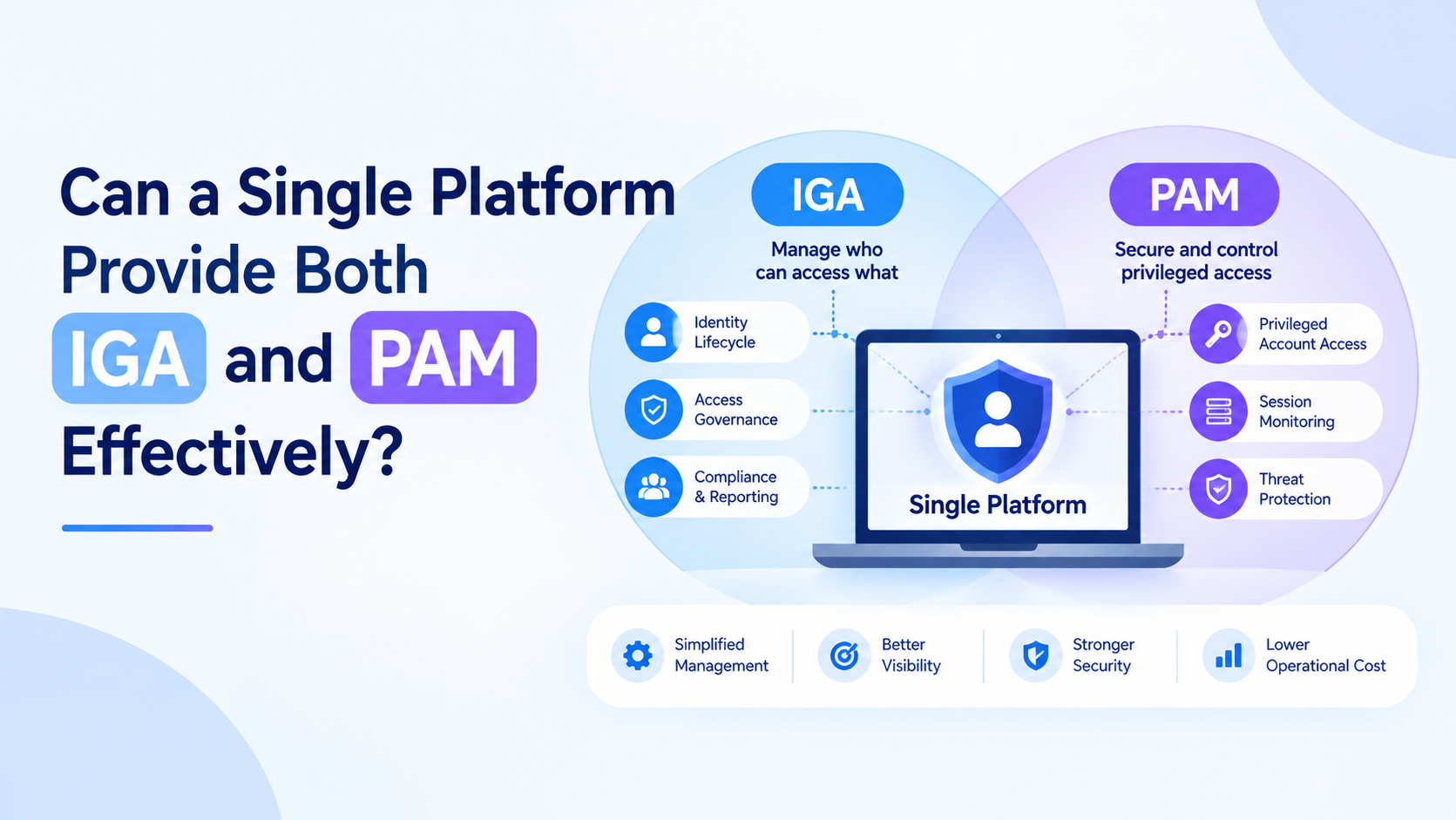
Choosing an identity platform is one of the longest-lived decisions a security organization makes. The commitment runs for years, touches every application and identity you have, and is difficult and expensive to reverse. Yet most evaluations are run on vendor demos and feature checklists, which is precisely the input least likely to reveal how a platform behaves in your environment.
This blog is a framework for doing it differently. It is written for the security architects who have to assess these platforms technically, and the CISOs who have to justify the choice to leadership.
What is true IGA-PAM convergence?
A converged identity platform delivers historically separate identity disciplines, identity governance and administration (IGA) and privileged access management (PAM), through a single system built on one data model, one policy engine, and one administrative layer. The architectural detail is what separates a converged platform from a bundle.
In a genuinely converged system, an access certification, a privileged session, and an entitlement change all read from and write to the same identity record and the same audit trail. That is very different from several products sharing a login screen while keeping separate data stores and policy logic underneath. Both get marketed as converged. Only the first delivers the single view of identity risk that justifies consolidation in the first place.
Why the category exists at all
The reason the category exists is that identity became the primary attack surface while the tools defending it stayed in silos. IGA knew what access was granted. PAM knew what privileged sessions happened. No single tool could answer whether a given identity’s combination of standing entitlements and privileged activity was a risk, because the data lived in different places.
Convergence is the response. Put the data in one model so the correlation becomes possible. That is the whole promise. Everything else is decoration.
| Model | What it is | What it does well | Where it breaks |
|---|---|---|---|
| True convergence | One data model, one policy engine, one audit layer | Unified risk view, correlated decisions, cleaner investigations | Harder to build and harder to do well |
| Surface-level integration | Separate tools behind one UI or portal | Easier selling, some operational convenience | Fragmented logic, weaker correlation, duplicate administration |
Why combining IGA and PAM on one platform is architecturally complex
IGA is about who should have access, whether that access is still appropriate, and whether it aligns with policy and compliance requirements. It focuses on provisioning, deprovisioning, access requests, certifications, segregation of duties, and role management. PAM is about how privileged access is granted and controlled when the stakes are highest. It focuses on credential vaulting, just-in-time elevation, session recording, break-glass access, and privileged approval workflows. The overlap is real, but it is not complete. IGA is usually periodic and policy-driven. PAM is often real-time, transactional, and exception-heavy. Any platform that combines them has to preserve those differences instead of flattening them into one generic control layer.
The difficult part is not putting both functions in one interface. The hard part is making them work together without sacrificing control depth. Governance logic and privilege logic are built around different assumptions. Governance cares about population-wide access posture. Privilege cares about specific high-risk actions in the moment. If a platform collapses both into a generic workflow engine, it may become easier to sell but harder to trust. Governance becomes too shallow. Privilege becomes too thin. Or the platform becomes strong in one area and merely acceptable in the other. That is the central tension in convergence, and any serious evaluation has to start there.
A credible converged platform should do three things well. It should keep governance logic distinct from privilege execution. It should correlate governance, privileged activity, and threat signals in real time. It should preserve a clean audit chain from entitlement to action to outcome. If those three things are missing, the platform may still be useful. It just is not doing the architectural work the category promises.
5 Signs your organization is ready for platform consolidation
Convergence is not the right move for every organization, and the honest first step in any evaluation is deciding whether you should consolidate at all or keep a best-of-breed stack. The more of the following indicators apply, the stronger the case for a unified platform.
- Tool sprawl is creating real operational drag: You are running separate IGA, PAM, and access management tools that do not share data, and your team spends more time reconciling information across consoles than acting on it.
- You cannot answer cross-domain questions quickly: When a simple question like which privileged users hold a toxic combination of entitlements requires a multi-day investigation, the gap convergence closes is one you actively feel.
- Your point tools are approaching renewal or end of life: Consolidation is far easier to justify and execute when existing contracts are expiring anyway, rather than writing off active investments.
- Your requirements are mainstream rather than specialized: If your governance, privileged access, and access needs are standard, a converged platform likely covers them well. If you have deep specialized requirements, such as CI/CD secrets management, mainframe session recording, or complex customer identity, best-of-breed may be the better fit.
- You have the operational maturity to run one platform well: Consolidation concentrates your identity program into one system. That is an advantage only if you have the process discipline to operate it. Organizations still building foundational IAM often benefit more from getting SSO, MFA, and basic governance right first.
If most of these do not apply, a phased best-of-breed approach may serve you better than consolidation, and a good evaluation says that out loud instead of forcing the platform case.
Core capabilities to evaluate in a converged identity platform
1. IGA depth
Provisioning and deprovisioning, access request workflows, certification campaigns, segregation-of-duties enforcement, and role management are the baseline. Ask specifically how certifications are run, since reviewer fatigue and rubber-stamping are where governance programs quietly fail regardless of the tool.
2. PAM coverage
Credential vaulting, just-in-time access elevation, session recording, and privileged access request workflows are the minimum. The key evaluation question is depth. Converged platforms often handle human privileged access governance well, but specialized needs like secrets management for CI/CD pipelines, vendor access with session isolation, or mainframe session recording often still exceed what a converged approach delivers.
3. Access management
Authentication, single sign-on, adaptive and context-aware access decisions, and support for strong authentication standards such as passkeys and hardware security keys should be consistent across the estate. A platform that treats access management as a bolt-on is not really converged; it is simply decorated.
4. The IGA-PAM signal loop
This is the capability that most distinguishes real convergence, and the one most often missing. In a converged platform, governance data, privileged activity, and threat detection should inform each other. An anomalous privileged session should be visible in the context of that identity’s standing entitlements. A risk signal should be able to trigger a re-certification or an access change.
When these signals flow in one loop rather than sitting in separate tools, identity becomes a live control rather than a periodic audit. Ask vendors to demonstrate this loop with a real workflow, not a slide.
5. Non-human and AI agent governance
Non-human identities now dominate most enterprise environments, and AI agents are growing fast. Confirm whether the platform governs service accounts, machine credentials, and agents within the same policy model as humans, and whether that capability is generally available today or a roadmap item. This is a fast-moving edge of the category where marketing often runs ahead of shipping features.
6. Integration and portability
Ask how the platform connects to your existing systems, and how easily data and configuration move in and out. Standards support, SCIM, OIDC, and SAML lower both integration cost and future exit cost, and they are the single most effective hedge against lock-in.
Hybrid environment compatibility checklist
Many enterprises are not fully cloud or fully on-premises, and a converged platform has to operate cleanly across both. This is where otherwise-strong platforms often reveal gaps, because cloud-native architectures can struggle with legacy systems and legacy-derived platforms can struggle with modern cloud workloads.
Work through this checklist against your actual environment:
- Legacy application coverage: Can the platform govern access to on-premises and legacy applications, not only modern SaaS?
- Multi-cloud reach: Does it provide consistent governance and access control across AWS, Azure, and Google Cloud, rather than favoring one?
- Directory coexistence: Can it operate alongside existing directories, including during a long migration, rather than requiring you to consolidate directories first?
- Federation support: Does it support federation-based parallel running, so you can transition application by application rather than in a single high-risk cutover?
- Consistent policy across environments: Is a policy defined once enforced the same way in cloud and on-premises, or do you maintain two policy sets?
- Non-human identity coverage across environments: Are service accounts and workload identities governed consistently whether they run on-premises, in the cloud, or in Kubernetes?
A platform that handles your modern stack beautifully but cannot govern the legacy systems still running your business is not a converged platform for your environment. Test against what you actually operate.
Weighted scoring framework for vendor comparison
Feature checklists produce ties, because every serious vendor checks most boxes. A weighted score forces the harder and more useful conversation: which capabilities matter most for your organization, and how well does each platform actually deliver them?
Use the framework below as a starting point. The weights are a reasonable default for a typical enterprise consolidating a fragmented stack. Adjust them to your priorities before scoring. Rate each platform 1 to 5 on every criterion, multiply by the weight, and sum. The exercise of setting the weights with your stakeholders is often as valuable as the final number, because it surfaces disagreement about priorities before a contract is signed rather than after.
| Evaluation criterion | Weight | What a 5 looks like | What a 1 looks like |
|---|---|---|---|
| Integration depth (single data model, not a bundle) | 20% | Live cross-capability workflow drawing on one identity record | “Single pane” that cannot join governance and privileged data |
| Capability depth in your priority domains | 20% | Meets your specific IGA, PAM, and access needs, including specialized ones | Mainstream coverage only, with gaps in your critical domain |
| Hybrid and multi-cloud compatibility | 15% | Consistent governance across legacy, on-premises, and all clouds | Strong in one environment, weak in the others you run |
| IGA-PAM signal integration | 15% | Signals demonstrably flow in one loop | Capabilities present but siloed |
| Migration path and portability | 15% | Phased, federation-based cutover, full standards support | Big-bang migration, proprietary formats |
| Non-human and AI identity coverage | 10% | Governs machines and agents in the same model, generally available today | Human-only, or roadmap-only |
| Operating model fit and total cost | 5% | Runs within your team’s capacity, predictable pricing | Requires heavy services, pricing escalates at scale |
Two rules that keep the score honest
First, score against demonstrated behavior in your environment or a realistic proof of concept, not against demo-environment claims. The demo is the minimum bar, not evidence.
Second, treat any criterion where your top requirement is a roadmap item rather than a shipping feature as a 1 or 2, regardless of how compelling the roadmap sounds. Weight your decision toward what you can deploy now.
One finding from the field is worth carrying into the whole exercise. The platform tends to stop being the deciding factor by roughly month 18 of ownership. What determines success after that is the operating model, how certifications, exceptions, and evidence are actually run. Score the platform, but remember you are also committing to an operating model, and budget for it accordingly.
Start your converged identity platform evaluation with ObserveID
ObserveID is built for organizations that want the benefits of convergence without pretending the architectural problems do not exist. It brings together IAM, IGA, PAM, CIEM, identity lifecycle management, identity intelligence, and threat detection into a single platform so teams can manage identity risk from one system instead of a patchwork of disconnected tools.
That matters because the goal is not merely to reduce vendor count. The goal is to improve how identity decisions are made, enforced, and audited. ObserveID is designed to give teams centralized visibility, automated governance, continuous monitoring, and policy enforcement across on-premises, hybrid, and multi-cloud environments.
Ready to evaluate with a clear picture of your environment? Book a demo with ObserveID to see how a converged identity platform can support both IGA and PAM in a way that is practical, defensible, and built for enterprise reality.
Frequently Asked Questions
1. What are the key capabilities to look for in a converged identity security platform?
Look for one identity model, mature IGA and PAM capabilities, real-time correlation between governance and privilege events, hybrid and multi-cloud support, non-human identity coverage, and standards-based integration.
2. What are the risks of keeping IGA and PAM separate, siloed tools?
The biggest risks are fragmented visibility, inconsistent policies, slower investigations, duplicated administration, and weaker correlation between entitlement risk and privileged activity.
3. How does a converged identity platform support hybrid and multi-cloud environments?
It should enforce consistent policy across legacy applications, on-premises systems, cloud platforms, and directories. It should also support federation, coexistence, and governance for non-human identities across those environments.