
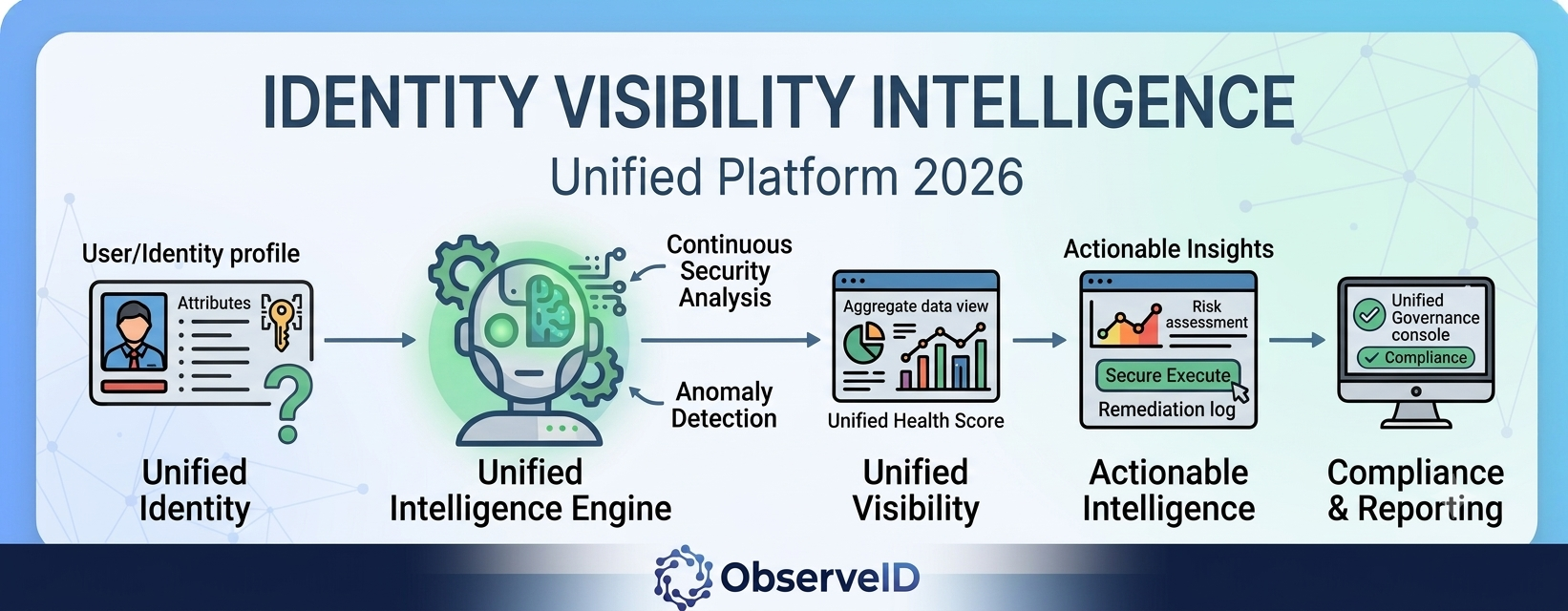
Many organizations run a full stack of identity tools, yet none of those tools can show the complete picture: every identity, everything it can access, and whether that access is a risk. Identity data sits fragmented across directories, cloud consoles, and applications, and the gaps between them are where breaches start.
Identity Visibility and Intelligence Platforms (IVIP) exist to close that gap. This article explains what an IVIP is, how it works, and how to evaluate one in 2026.
What is Identity Visibility & Intelligence (IVIP)?
An Identity Visibility and Intelligence Platform is a technology layer that unifies identity data from across your entire environment into a single, continuously updated view, and applies analytics to turn that view into actionable risk intelligence. The category is defined by one deliverable: a single view of identity data, activity, relationships, configuration, and posture that makes every other identity control in the stack more effective.
The important word is layer. An IVIP does not replace your identity provider, your governance platform, or your privileged access tool. It sits across all of them, connects the data each one holds in isolation, and answers the questions none of them can answer alone: who can access what, across everything, and should they. IVIP is also one of the youngest categories in identity security, with market penetration still below 5%, which makes it one of the few areas where adopting early still confers a real advantage.
The category exists because identity became the primary attack surface while identity data stayed the least trusted dataset in the enterprise. Enforcement tools multiplied. The unified picture never did.
Core IVIP capabilities: Ingestion, normalization, correlation, and relationship mapping
Four capabilities define the category, and they operate as a pipeline. Each one depends on the one before it.
1. Ingestion: The platform connects to every system that holds identity-relevant data: directories, identity providers, HR systems, cloud IAM, SaaS applications, PAM vaults, secrets managers, and activity logs. Speed matters here. A visibility layer that takes a year to connect is describing last year’s environment.
2. Normalization: The same person exists as five different account records in five different systems, each with its own schema and naming conventions. Normalization translates all of it into one consistent data model, so an account in the cloud provider and an account in the HR system can be compared at all.
3. Correlation: This is where accounts become identities. The platform links every account, credential, key, and token to the identity behind it, whether that identity is a human employee or a service running in production. Correlation is what turns “we have 40,000 accounts” into “we have 6,000 identities, and here is everything each one holds.”
4. Relationship mapping: The final step builds the graph, which identifies which identities hold which entitlements, which entitlements grant access to which resources, who owns each account, and how access chains together across systems. The graph is what makes the hard questions answerable. Blast radius, toxic combinations, and orphaned access are all graph queries, and without the graph, they are multi-week investigations.
Human vs. non-human identities: Why unified visibility matters
The case for unified visibility would be strong if enterprises only had employees. They do not. Service accounts, API keys, cloud roles, workload identities, and AI agents now dominate the identity population, and non-human identities outnumber human ones by roughly 82 to 1.
The two populations fail differently. Human identities have managers, review cycles, and offboarding processes. Non-human identities are created by scripts, live outside HR-driven lifecycles, and rarely have an owner anyone can name. A visibility program that covers only the human 1% of the estate is not a visibility program.
They also cannot be secured separately, because attacks cross the boundary. A phished employee credential is used to mint a new API key. A compromised service account is used to reset a human account’s MFA. If your human identities live in one tool’s view and your machine identities in another’s, the attack path between them is invisible to both. Unified visibility means one inventory, one graph, and one risk model covering every identity type, which is precisely what the IVIP category requires and what legacy IAM architectures were never designed to produce.
IVIP vs. ITDR, IGA, and PAM: Understanding the category landscape
IVIP gets confused with the categories it serves. The distinction is enforcement versus intelligence: IGA, PAM, and ITDR act on identities, while IVIP is the layer that lets them act on accurate information.
| Category | Primary job | Question it answers | What it lacks without IVIP |
|---|---|---|---|
| IGA | Access lifecycle: provisioning, certification, deprovisioning | Was this access granted and reviewed correctly? | Whether granted access is actually used, and what exists outside its connected apps |
| PAM | Vaulting and brokering privileged credentials | Are privileged credentials controlled? | Privileged access that never entered the vault, including cloud roles and standing keys |
| ITDR | Detecting and responding to identity-based attacks | Is an identity being attacked right now? | Cross-system context: ownership, entitlement history, and what the compromised identity can actually reach |
| IVIP | Unified visibility and intelligence across all of the above | Who can access what, across everything, and should they? | Enforcement. IVIP informs the other three; it does not replace them |
The practical relationship is that IVIP feeds the others. Certifications run on real usage data instead of stale entitlement lists. PAM onboarding is driven by discovered privileged access rather than what teams remembered to register. ITDR alerts arrive with ownership and blast radius attached. This is also why analysts describe IVIP as the backbone of the identity fabric: integration between IAM tools does not fix inconsistent data, and IVIP is the layer that gives every tool the same accurate picture to work from.
Key use cases: Blast radius analysis, orphaned accounts, and toxic access detection
Three use cases show what the unified graph makes possible.
1. Blast radius analysis: When an identity is compromised, the first question is what the attacker can now reach. With fragmented data, that answer takes days of manual tracing, which is time the attacker spends using the access. With an identity graph, it is a query: this identity, every credential it holds, every entitlement attached, every resource reachable, including through group memberships and delegated access. Incident response starts with a map instead of an archaeology project.
2. Orphaned account detection: Accounts that outlive their owners are a standing gift to attackers: valid, often privileged, and watched by no one. They accumulate wherever deprovisioning misses a system, which is everywhere over enough time. Correlation exposes them mechanically. Any account that cannot be linked to an active, accountable identity surfaces immediately, rather than in next year’s audit.
3. Toxic access detection: Some access is dangerous only in combination. An identity that can both create a vendor and approve payments to one. An engineer who can push code and also approve their own deployment. Each entitlement passes review on its own, because reviews happen system by system. Toxic combinations only become visible when entitlements from different systems are evaluated together, which requires exactly the cross-system graph an IVIP maintains.
Each of these is also a differentiation story. The organization that answers a blast radius question in minutes, produces a zero-orphan report on demand, and demonstrates separation-of-duties enforcement across systems is a different vendor in a security review and a different defendant in an audit than one that needs three weeks and six spreadsheets. With category adoption still below 5%, that gap between you and competitors is currently wide open.
How to evaluate Identity Visibility & Intelligence platforms in 2026
The category is young, which means the label is applied loosely. These criteria separate genuine IVIPs from rebranded dashboards.
| Criterion | What to look for | Red flag |
|---|---|---|
| Coverage | Every identity type: human, service account, key, token, cloud role, AI agent | “Machine identity support on the roadmap” |
| Integration speed | Days to connect core systems, agentless where possible | Professional services quoted in quarters |
| Correlation depth | Accounts resolved to identities with ownership attached | Aggregated lists that still show accounts, not identities |
| Freshness | Continuous updates; the graph reflects today | Scheduled syncs measured in weeks |
| Intelligence | Risk scoring, anomaly detection, usage analysis on top of the data | Visibility without analytics; a repository, not an intelligence layer |
| Downstream action | Feeds findings into your IGA, PAM, ITDR, and ticketing workflows | Insights trapped in the platform’s own console |
One more test matters and does not fit a table: ask the vendor your own hardest question. Which accounts hold admin in production, who owns each one, and when was that access last used. A real IVIP answers during the demo.
Build unified identity intelligence with ObserveID
ObserveID delivers the IVIP capabilities this article describes as one platform, built for the identity environment enterprises actually run in 2026. It ingests identity data from across the environment, including directories, cloud IAM, SaaS applications, and the systems that hold non-human credentials, then normalizes and correlates it into a single inventory where every account, key, and token resolves to an identity with a named owner. Human users, service accounts, machine credentials, and AI agents live in the same graph, so the questions that cross identity types, which are the questions attacks actually raise, have one place to be answered.
On top of the graph, ObserveID adds the intelligence layer that separates visibility from a data warehouse. It learns a behavioral baseline for every identity and scores risk continuously, so blast radius is a query you run in minutes, orphaned accounts surface as they appear rather than at audit time, and toxic access combinations are flagged across systems that have never compared notes before. When something drifts from normal, the alert arrives with ownership, history, and reachable access attached, which is the context that turns detection into fast containment.
ObserveID also honors the rule that defines the category: it strengthens your existing stack rather than replacing it. Findings feed your governance reviews, your PAM onboarding, your ITDR triage, and your audit evidence, so the tools you have already bought finally operate on the same accurate, current picture of identity. That is what unified identity intelligence means in practice, and it is available now, while adopting it early still sets you apart.
See every identity, every entitlement, and every relationship in one graph. Book a demo with ObserveID.
Frequently asked questions
1. How is IVIP different from IAM, IGA, PAM, and CIEM?
The difference is enforcement versus intelligence. IAM authenticates and authorizes access at the point of login. IGA manages the access lifecycle: provisioning, certification, and removal. PAM vaults and brokers privileged credentials. CIEM manages entitlements within cloud infrastructure specifically. Each enforces controls inside its own domain, and each sees only its own slice of the environment. An IVIP is the layer above all of them: it unifies their data, adds usage and relationship context, and feeds intelligence back so every enforcement tool operates on an accurate, complete picture.
2. Why do organizations need identity visibility and intelligence if they already have existing IAM tools?
Because the gaps between tools are where identity risk lives. Orphaned accounts sit in systems your IGA never connected. Privileged access accumulates outside the PAM vault. Attack paths cross from a SaaS credential to a cloud role without any single tool seeing both ends. Existing IAM tools enforce policy well inside their own boundaries, but none of them can answer who can access what across everything. An IVIP exists to answer exactly that question, and to make the tools you already own more effective with the context they individually lack.
3. What types of identities does an Identity Visibility & Intelligence Platform cover?
All of them, in one inventory: human identities such as employees, contractors, and partners, and non-human identities such as service accounts, API keys, machine credentials, cloud roles, workload identities, and AI agents. Unified coverage matters because non-human identities now outnumber human ones by roughly 82 to 1, and because attacks routinely cross between the two populations, a phished human credential minting a new API key, or a compromised service account resetting a human account’s MFA. A platform that covers only one population misses the path between them.
4. How does an Identity Visibility & Intelligence Platform support a zero-trust architecture?
Zero trust requires continuous verification of every identity and every access decision, and continuous verification is only possible with continuous visibility. An IVIP supplies the foundation: a current inventory of every identity, its entitlements, its behavior against a learned baseline, and its risk score. That intelligence feeds policy engines and access decisions, so verification reflects what an identity is actually doing rather than what was assumed about it at login. Without this layer, zero trust remains an architecture diagram rather than an operating practice.
5. How does identity intelligence improve compliance and audit readiness?
It replaces reconstruction with records. Audits ask who has access to regulated systems, whether that access was reviewed, whether separation of duties holds, and whether departed users were fully deprovisioned. With fragmented identity data, answering those questions means weeks of exports and spreadsheets assembled after the fact. With a unified identity graph, the answers are queries against evidence the platform generated continuously as the environment ran: complete inventories, usage-backed certifications, cross-system separation-of-duties checks, and zero-orphan reports produced on demand.
6. What core capabilities should you look for when evaluating an Identity Visibility & Intelligence Platform?
Six capabilities separate genuine platforms from rebranded dashboards. Coverage of every identity type, human and non-human, including AI agents. Rapid, agentless integration measured in days rather than quarters. Correlation depth that resolves accounts to identities with named owners attached. Continuous freshness, so the graph reflects today rather than the last sync. Analytics on top of the data: risk scoring, anomaly detection, and usage analysis. And downstream action, meaning findings flow into your IGA, PAM, ITDR, and ticketing workflows instead of staying trapped in the platform’s own console.