
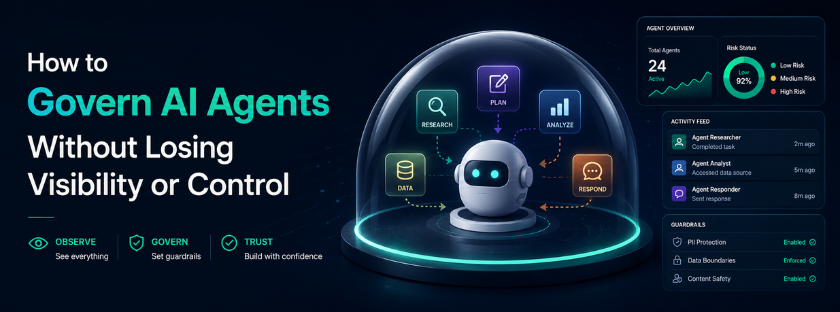
Every enterprise that deploys AI agents faces the same tension. Lock agents down too hard, and the business routes around security, spinning up ungoverned agents on whatever platform lets them move fastest. Leave them loose, and you accumulate a population of autonomous software with real credentials, real data access, and nobody watching what it does. Neither extreme works. The way out is to treat agents the way you treat any other identity in your environment, with a full lifecycle of ownership, scoped access, and continuous monitoring, while accepting that agents break several assumptions the old identity playbook was built on.
This guide covers what makes agents different, where governance actually fails in practice, and a lifecycle model for keeping control without slowing adoption.
What makes AI agents harder to govern than service accounts
The instinct in most organizations is to file agents under existing non-human identity processes: register a service account, issue an API key, move on. That model fails for agents in specific, predictable ways.
A service account is static. It performs the same task the same way, so its permissions can be defined once and its behavior monitored against a simple rule. An agent reasons toward a goal. It decides at runtime which tools to invoke, which data to pull, and in what order. Some frameworks let agents spawn sub-agents, each inheriting some portion of the parent’s authority through a delegation chain that nobody explicitly approved. Many agents are also ephemeral; they exist for minutes to complete a task, then disappear, leaving credentials and audit questions behind.
| Governance dimension | Service account | AI agent |
|---|---|---|
| Behavior | Fixed task, same pattern every run | Goal-driven, varies by task and context |
| Permissions | Defined once at provisioning | Requested and exercised dynamically at runtime |
| Lifespan | Long-lived, stable | Often ephemeral; spun up and down per task |
| Delegation | None | Can spawn sub-agents and act on behalf of users |
| Attribution | Maps to one function | Actions must trace through a delegation chain to a human |
The delegation problem deserves particular attention because it’s where accountability quietly disappears. When an agent acts on behalf of a user who invoked it through another agent, which authenticated through a shared credential, the question “who did this?” has no clean answer. Auditors ask that question. So do incident responders.
Where does AI agent governance break down?
Four failure modes account for most of the real-world incidents.
1. Shadow agents: Teams deploy agents outside security review, connecting them to production APIs with hardcoded credentials or personal developer tokens. As agent-building tools get easier, the barrier to standing up an ungoverned agent drops every month. These agents can’t be audited or terminated because nobody knows they exist.
2. Privilege drift: Agents request access as they work, and access granted for one task tends to persist. Over months, an agent accumulates permissions far beyond its purpose. Since no certification cycle covers it, nobody trims the excess.
3. Unsecured integration paths: Most agents reach enterprise systems through Model Context Protocol servers or similar connectors. Research cited by Palo Alto Networks found 38% of MCP servers in the wild ship with no authentication at all, and even authenticated ones often verify only the human user’s consent, leaving the agent itself invisible to identity systems. Agents that can’t reach data through a sanctioned path will sometimes find another one, which turns your governance layer into a suggestion.
4. No off switch: When an agent starts behaving unexpectedly, many organizations discover they can monitor the behavior but not stop it. Revoking access means hunting down tokens across half a dozen systems while the agent keeps running.
A lifecycle model for governing AI agents
The controls that work map onto the same joiner-mover-leaver logic you already run for people, adjusted for how agents actually behave.
| Lifecycle stage | Control | Failure it prevents |
|---|---|---|
| Discover | Continuous scanning for agents, known and unknown, including OAuth grants and MCP connections | Shadow agents |
| Register | Unique identity per agent, in a directory, with a named human owner | Orphaned accounts, unclear accountability |
| Scope | Least-privilege access via short-lived credentials issued per task, not standing tokens | Privilege drift, credential theft |
| Monitor | Behavioral baseline per agent; alert on deviation, log every action with its delegation context | Silent misuse, broken audit trails |
| Retire | Automated deprovisioning plus a kill switch that blocks new token requests immediately | Dormant agents, uncontainable incidents |
Two of these stages carry most of the weight. Discovery comes first because every downstream control assumes an inventory; an agent you haven’t found can’t be owned, scoped, or monitored. And monitoring is what separates governance on paper from governance in fact. An agent’s permissions tell you what it could do. Only its behavior tells you what it’s doing, and whether that still matches its purpose.
Ownership is the cheapest control on the list and the most neglected. Assigning every agent a named human owner costs nothing and immediately answers the question that stalls most incident responses: who do we call about this thing?
Does strong agent governance differentiate you?
It does, in a way that’s easy to underestimate, i.e., governance is what lets you deploy more agents, not fewer. Organizations without agent governance end up in one of two postures. Either security blocks agent deployments because it can’t assess the risk, or AI initiatives stall while competitors ship. Or the business deploys anyway, and risk accumulates invisibly until an incident forces a freeze. Both outcomes are slow.
An organization that can discover, own, scope, and monitor agents can say yes quickly. A new agent gets registered, assigned an owner, granted scoped access, and baselined, a process, not a debate. That speed shows up externally, too. Enterprise customers and regulators are beginning to ask pointed questions about agent access controls in security reviews. Being able to answer with an inventory, an ownership record, and an audit trail, rather than a policy PDF, is becoming a genuine commercial advantage in regulated industries, the same way SOC 2 readiness was a decade ago.
How ObserveID helps
ObserveID treats AI agents as what they are: a fast-growing identity class that needs the same lifecycle rigor as every other identity in the environment, delivered at the speed agents actually operate. It continuously discovers agents across the environment, including the unsanctioned ones connecting through OAuth grants and MCP servers outside formal review, and brings each into a single inventory alongside human users, service accounts, and machine credentials. Every agent gets a unique identity and a named owner, which closes the accountability gap that most organizations haven’t addressed at all.
From there, ObserveID builds a behavioral baseline for each agent from its observed activity. Because an agent’s permissions say little about its actual behavior, this is the layer that catches the problems that matter: an agent reaching systems outside its normal pattern, exercising dormant permissions, or acting in sequences its purpose doesn’t explain. Alerts arrive with the agent’s history, ownership, and delegation context attached, so an analyst can tell within minutes whether they’re looking at a new workflow or a hijacked credential.
ObserveID also handles the end of the lifecycle, which is where agent governance most often falls apart. It tracks whether agents are still active, flags the dormant ones still holding access, and supports immediate revocation when an agent misbehaves, so containment doesn’t depend on hunting tokens across systems while the clock runs. Findings feed directly into the access reviews and audit evidence your team already produces, which means agent governance becomes part of how the identity program runs rather than a separate project bolted on top.
See every AI agent in your environment, who owns it, what it can reach, and what it’s actually doing. Book a demo with ObserveID.
Frequently asked questions
1. Should AI agents have their own identities, or run under the user they serve?
Their own. An agent running under a user’s identity makes attribution impossible and inherits far more access than any single task requires. A unique agent identity, linked to the human it acts for through a recorded delegation chain, preserves both least privilege and accountability.
2. How is AI agent governance different from AI governance generally?
AI governance covers model risk, bias, and acceptable use. Agent governance is narrower and more operational: it’s identity and access management for autonomous software, who the agent is, what it can reach, what it did, and who answers for it.
3. What’s the first step if we have agents running today with no governance?
Inventory. Run discovery across your identity provider, OAuth consent grants, and MCP connections before writing any policy. Most organizations find substantially more agents than they expected, and every later control depends on knowing what exists.