
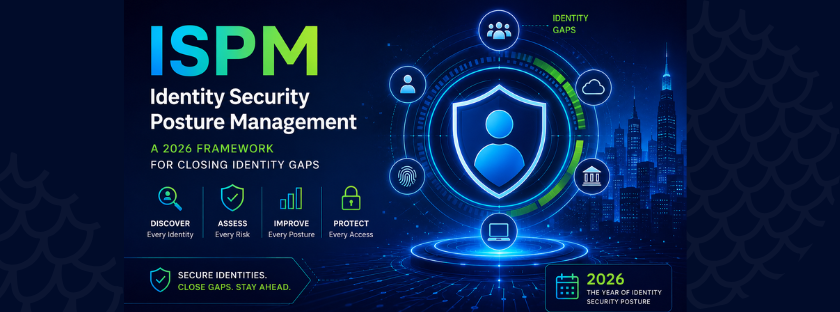
Identity has quietly become the primary attack surface in enterprise security, and a new discipline has grown up to defend it, i.e., Identity Security Posture Management, or ISPM. If your team is still assessing identity risk through periodic access reviews and an assumption that MFA is “on everywhere,” this guide is a way to check where you actually stand, and to understand why the market has moved decisively toward continuous posture management.
What is Identity Security Posture Management (ISPM)?
Identity Security Posture Management is the continuous discipline of assessing, monitoring, and reducing identity-related risk across every environment an organization runs, cloud, on-premises, and hybrid. It covers every human user and every non-human identity, such as service accounts, API keys, OAuth tokens, SSH keys, cloud IAM roles, and AI agents.
ISPM is not a single product. It’s a framework of processes and tools that together answer one deceptively hard question: who and what can take which action on which data, and is any of that access a risk? It surfaces the specific weaknesses that erode identity security, misconfigurations, over-provisioned accounts, dormant identities, excessive permissions, and unmonitored non-human identities, and it does so continuously rather than on a quarterly cycle.
It helps to distinguish ISPM from the two adjacent disciplines it’s often confused with. Identity governance (IGA) manages the lifecycle of access, who should have what. Identity threat detection and response (ITDR) detects and responds to active attacks in progress. ISPM sits between them: it’s the proactive, preventive layer that finds and fixes identity weaknesses before an attacker can exploit them. The three work together, but they answer different questions, and none substitutes for the others.
Why identity security posture should be a priority in 2026
The reason posture management has moved to the center of security strategy is a shift in how attacks take place. Adversaries have largely stopped breaking in and started logging in.
The 2026 data makes the point without embellishment. Sophos’s State of Identity Security 2026, drawn from 5,000 IT and security leaders across 17 countries, found that 71% of organizations experienced at least one identity-related breach in the past year. Palo Alto Unit 42, reviewing more than 750 incident response engagements, found identity weaknesses played a material role in nearly 90% of investigations. When an attacker uses a valid credential, most traditional defenses never fire, there’s no exploit, no malware signature, no rule being broken. The intruder looks like a legitimate user because, to the system, they are one.
Non-human identities make the problem worse. They now outnumber human identities in most enterprises, by ratios as high as 100 to 1, and they’re governed far more loosely. Unit 42’s analysis of over 680,000 cloud identities found that 99% of cloud users, roles, and services carried excessive permissions, much of it unused for 60 days or longer. Every over-permissioned, under-monitored identity is a standing door into the environment. ISPM exists to find those doors and close them.
Five most common identity security posture weaknesses
ISPM is easiest to understand through the specific weaknesses it’s built to catch. Each of the following is a common, fixable gap, and each is a place worth checking in your own environment right now.
1. MFA that is not enforced everywhere
Multi-factor authentication is the baseline identity control, and nearly every organization assumes it’s universally enforced. In practice, enforcing it correctly means aligning your identity provider, your MFA system, and hundreds of individual application settings. Gaps slip in through legacy applications, forgotten exceptions, and session-handling loopholes. If you can’t name every account and application where MFA is genuinely enforced, that uncertainty is itself a posture weakness.
2. Over-provisioned and unused permissions
Identities accumulate access over time and rarely give any back. Permissions granted for a short-lived project persist. Access from a prior role carries into the new one. The result is a population of identities that can reach far more than they need which means any single compromise has a far larger blast radius than it should. Least-privilege enforcement, driven by actual usage data, is one of the highest-impact moves in ISPM.
3. Forgotten and unmanaged service accounts
Service accounts run applications, automate tasks, and make API calls, often with substantial privileges. When one falls out of active use but keeps its permissions and its monitoring lapses, it becomes an ideal target: valid, powerful, and invisible. Sophos found that only about a third of organizations regularly audit or rotate their service accounts and non-human identities, leaving the majority exposed on exactly this front.
4. Shadow access and local logins
Shadow access is the unmanaged local account someone keeps to an application for convenience or faster troubleshooting. These logins rely on static credentials, rarely get documented, and live outside normal controls. A high-privilege local account that is not being watched is among the most exploitable things in any environment.
5. AI agents operating without oversight
This is the fastest-growing gap. AI agents can generate their own credentials and request broad, persistent access, frequently without a human approving each grant. An agent with standing access and no monitoring is precisely the blind spot attackers are learning to hunt for. Knowing which agents run in your environment, what they can reach, and what they’ve actually been doing is now a core ISPM requirement, not an edge case.
| Posture signal | Weak posture | Strong posture |
|---|---|---|
| MFA coverage | Assumed universal, never verified | Confirmed per account and app, exceptions tracked |
| Permissions | Accumulate, rarely revoked | Continuously trimmed to actual usage |
| Service accounts | Unknown count, unmonitored | Inventoried, usage-tracked, right-sized |
| Shadow / local access | Undocumented, unmanaged | Discovered and brought under control |
| AI & non-human identities | Invisible, unaudited | Discovered, baselined, monitored |
| Detection window | Weeks to months | Continuous, behavior-based |
How to assess your identity security posture
A practical posture assessment comes down to answering a short list of questions honestly. Treat these as a starting audit:
- Can you produce a complete inventory of every identity in your environment, human and non-human, along with what each one can access?
- Do you know which permissions across your estate haven’t been used in the last 60 days?
- Can you confirm there’s no path to a privileged account that bypasses your privileged access controls?
- Do you know every AI agent currently operating, and what it’s touching?
- If an attacker logged in tonight with a valid credential, how long would it take you to notice, and how far could they reach before you did?
Most organizations discover meaningful gaps in at least half of these. That’s not a failure of effort; it’s a reflection of how quickly the identity estate has outgrown the tools built to govern it. The value of ISPM is that it turns this from a once-a-quarter manual exercise into something running continuously in the background.
How ISPM differs from IAM, IGA, and ITDR
Legacy identity tools were never designed to answer posture questions. Single sign-on and IAM verify identity at the point of access. IGA governs the lifecycle of who should have what. ITDR reacts to attacks already underway. Each is essential, and none of them is built to continuously surface the misconfigurations, drift, and blind spots that quietly degrade posture over time.
This is why ISPM has emerged as its own category rather than a feature bolted onto existing tools. Producing a true picture of identity risk requires correlating data across identity logs, cloud configurations, permission structures, and behavioral patterns that no single legacy system holds on its own. ISPM is the layer that unifies those signals into one continuous, risk-driven view.
Why a strong identity posture is a competitive advantage
It’s tempting to file ISPM under risk reduction, necessary, but purely defensive. That undersells what a strong posture actually delivers.
Consider the conversations that happen outside the security team. When access reviews run on real usage data instead of a manager’s best guess, recertification becomes something you can defend in an audit rather than a rubber stamp. When you can show a regulator or an enterprise customer’s security review team current evidence of how access is monitored, not just a policy document describing how it should work, you’re negotiating from strength. Cyber insurers have tightened requirements around exactly these controls, which means posture increasingly shapes what coverage you can obtain and at what cost.
There’s a speed dividend too. An organization that knows its identity estate cold can adopt a new SaaS platform, onboard a team, or deploy a new AI agent without turning each initiative into a security bottleneck, because the controls and monitoring are already in place. Weak posture makes every new project slower, because every project adds risk nobody can see. Strong posture turns identity from the thing that holds initiatives up into the thing that lets them move.
How ObserveID helps improve your identity security posture
The hardest part of ISPM is finding the weaknesses. Most identity tools weren’t built to expose their own misconfigurations and blind spots, because doing so requires collecting and correlating telemetry that no single system holds. This is the gap ObserveID is built to close.
ObserveID continuously discovers every identity in the environment, human users, privileged accounts, service accounts, machine credentials, and AI agents, and maintains a live picture of what each can access and what it’s actually doing. That’s what turns the assessment questions above from a manual quarterly project into something running constantly. The forgotten service account, the local login outside your identity provider, the permission unused for months, the AI agent quietly holding standing access: these are exactly the blind spots ObserveID is designed to surface before an attacker finds them first.
It doesn’t stop at discovery. ObserveID builds a behavioral baseline for each identity, so when something drifts from normal, a service account reaching a system it’s never touched, an account still active long after its owner left, it surfaces with the context an analyst needs to act, rather than as one more alert with nothing behind it. And because posture is a state you maintain rather than a project you finish, ObserveID feeds its findings directly into the reviews, triage, and audit evidence security teams already produce, so your posture reflects how the environment actually behaves rather than how it was configured on paper.
Conclusion
Identity security posture comes down to two numbers: how quickly you’d notice an attacker using valid credentials, and how much they could reach before you did. Every weakness in this guide is a lever on one or the other, and ISPM is the discipline that keeps both in check continuously.
Strong posture doesn’t mean nothing ever goes wrong. It means the things that go wrong stay small, visible, and caught early, instead of quiet, invisible, and discovered in a breach report months later. In an era where attackers log in rather than break in, that difference is the entire game.
See your real identity security posture, every identity, every permission, every blind spot, with ObserveID. Schedule a demo today.