
For most of the last decade, enterprise identity management was treated as an operational concern, a necessary infrastructure, but not a strategic territory. You deployed an identity provider, enforced multi-factor authentication, stood up single sign-on, and moved on. The real security investment went toward network controls, endpoint detection, and SIEM tuning.
That model made sense when users were mostly employees, accessing mostly on-premises systems, from mostly known locations. None of those assumptions holds anymore. The workforce is distributed. The applications are cloud-native, and the entities requesting access are no longer primarily human.
What has emerged is a new kind of identity problem, sprawling, dynamic, and largely invisible to the tools built to handle the old one. The organizations that recognize this shift and redesign their identity posture around it will carry a material security advantage into the next several years. Those that don’t will keep addressing identity-related incidents as isolated failures rather than symptoms of a structural gap.
“Credential compromise is the leading cause of breaches. Yet many organizations still treat identity and access management as a compliance function rather than a strategic control. That is the core vulnerability, and it is architectural in nature.”
Why Identity Has Become the Foundation of Enterprise Security
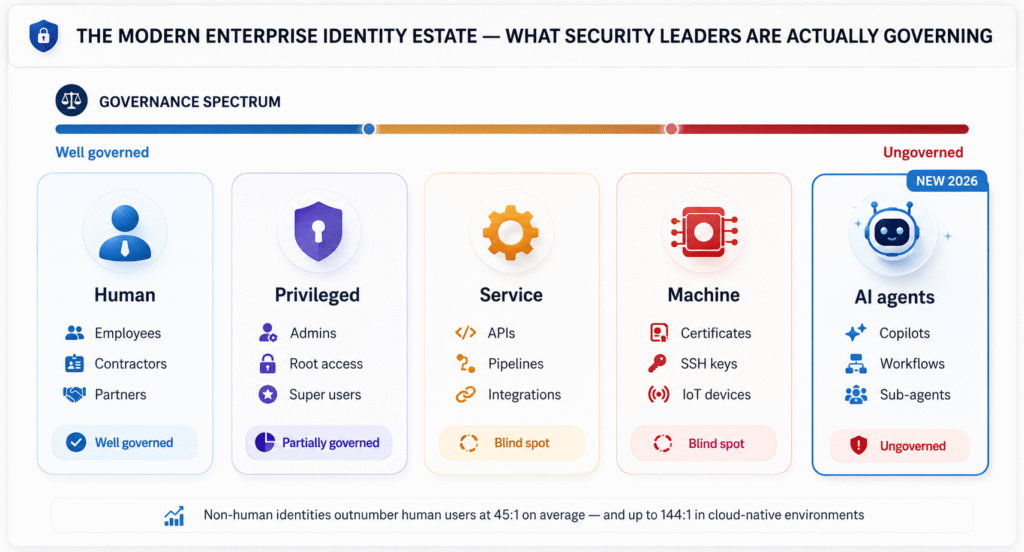
Today’s enterprise identity population looks almost nothing like the one identity management systems were designed for. Alongside the human workforce sits an enormous and largely invisible population of service accounts, API tokens, machine certificates, SSH keys, IoT devices, and, increasingly, AI agents. As enterprises expand across cloud and AI-driven environments, non-human identities frequently outnumber employees by 100:1 or more, with some organizations reporting ratios as high as 500:1. Many of these identities operate with excessive permissions, dramatically increasing the attack surface. And most of the governance processes built over the past decade were never designed to operate at that ratio or that speed.
The result is a predictable pattern: human identities get managed carefully, and everything else accumulates. Service accounts proliferate as applications are integrated and developers take shortcuts. Machine credentials get issued, then forgotten. API tokens get hardcoded into repositories and never rotated. According to CSA research, over 16% of organizations lack visibility into the creation of AI-related identities, leaving a growing segment of their identity ecosystem unmanaged. The access surface grows faster than the governance program, and the gap between the two is where breaches happen.
Agentic AI has created a qualitatively new governance challenge
Earlier generations of non-human identity, a scheduled batch job, an integration service account were relatively static. They held credentials, ran their task, and did little else. AI agents are fundamentally different actors. They are autonomous systems that acquire permissions dynamically at runtime, spawn sub-agents, invoke external APIs, write and execute code, and chain together actions that can span dozens of systems. The credential an agent holds is not a passive key; it is the identity of an actor whose behavior, by design, may expand beyond what its original configuration anticipated.
The enterprise deployment of these systems has accelerated sharply. 88% of organizations reported confirmed or suspected AI agent security incidents in the last year. And only 22% of teams treat AI agents as independent, identity-bearing entities; most still rely on shared API keys or treat agents as extensions of human users. The risk this creates is not hypothetical. It is already materializing, and the organizations that have not extended their identity governance to cover agent identities are carrying an exposure that grows with every new deployment.
Tool sprawl is the architectural problem underneath the access problem
Ask most enterprise security teams to describe their identity stack and they will describe a collection of tools that were each acquired to solve a specific problem at a specific moment. An IGA platform for access certifications. A PAM tool for privileged accounts. An IdP for authentication and maybe an ISPM tool layered on top to assess posture. Each tool works, in isolation, for what it was built to do. The problem is that they do not share context. Identity signals from the authentication layer never reach the governance system. Anomalies detected in one part of the stack are invisible to the rest.
This fragmentation is not merely inconvenient but a structural vulnerability. Only a third of security leaders are confident their current identity provider protects against identity-based attacks. When the teams responsible for access governance and threat detection operate on different data from different systems, the seams between those tools become the most exploitable territory in the enterprise.
What a coherent identity platform strategy requires
An identity platform strategy is a design philosophy, an agreement about how identity governance, access control, threat detection, and lifecycle management should work as an integrated system rather than as adjacent programs. The practical expression of that philosophy rests on five connected capabilities. Here are five capabilities that define a mature identity platform strategy:
1. Unified identity inventory across all entity types:
A continuously updated, single view of every identity in the enterprise: employees, contractors, service accounts, machine certificates, API tokens, and AI agents. Not a quarterly audit. A live system of record. Most organizations cannot answer the question “what identities exist in our environment right now?” for all entity types simultaneously. That gap is where governance breaks down.
2. Automated lifecycle governance at machine speed:
Provisioning, access reviews, and deprovisioning happen automatically and continuously, not on annual certification schedules. Orphaned accounts, over-provisioned service identities, and dormant credentials are the artifacts of lifecycle processes that cannot keep pace with the rate at which identities are created. Automation is a structural requirement.
3. Continuous, context-aware risk scoring:
Access decisions are informed by real-time behavioral signals rather than static policy rules written during the last security review. Zero trust, as actually implemented by leading organizations in 2026, means continuous verification built into every access decision, not an aspirational architecture slide. A session that starts clean but develops anomalous behavior should trigger re-evaluation mid-stream, automatically.
4. Just-in-time privileged access, with no standing privilege:
The model where administrators hold persistently elevated credentials has become indefensible given the blast radius of a single compromised account. The emerging standard is just-in-time privileged access: short-lived credentials provisioned on demand, scoped to a specific task, approved through a workflow, and automatically revoked when the work is complete. No standing privileges or persistent blast radius.
5. Identity threat detection integrated with the SOC
Identity signals, anomalous access patterns, credential stuffing attempts, privilege escalation, and session hijacking are among the highest-fidelity threat indicators available to any security team. Yet in most organizations, the identity governance function and the security operations center operate in separate organizational silos with data that never crosses. ITDR closes that gap, routing identity telemetry directly into detection and response workflows so that identity and security operations function as one program, not two.
Why this is a competitive differentiator, not just a defensive investment
The framing that limits most identity programs is the assumption that identity governance is a cost to be minimized rather than a capability to be leveraged. That framing produces reactive identity programs, adequate for audit purposes, but insufficient for the pace of the business. When access governance is automated and continuous, new applications can be onboarded in days instead of weeks. When AI agents are properly governed, the business can deploy them into production workflows with confidence rather than delay. When entitlement reviews happen inside the platform instead of in spreadsheets sent over email, compliance reporting becomes a byproduct of operations rather than a project that consumes six weeks of practitioner time each quarter.
The differentiation argument for security leaders is an identity program that functions as infrastructure keeps the organization safe. An identity strategy that functions as a control plane keeps the organization safe and makes it faster. The most successful CISOs in 2026 are strategic business partners who move beyond operational firefighting to proactive governance, using data-driven insights to anticipate threats and align security programs with business outcomes. Identity is where that shift is most visible and most measurable.
The organizations that get identity strategy right are not simply harder to breach. They are more capable of deploying new technology confidently, satisfying regulators without disruption, and extending their operations into new environments, cloud, hybrid, and agentic, without the access governance question becoming the bottleneck on every initiative.
How ObserveID helps
ObserveID is built for the identity reality of 2026, where enterprises need visibility across every kind of identity, not just human users. It creates a single, continuously refreshed inventory for human accounts, service accounts, privileged identities, machine credentials, API keys, and AI agents, giving security teams a true system of record instead of the usual guesswork dressed up as governance. From there, it automates lifecycle controls like provisioning, access reviews, and deprovisioning through auditable workflows, which helps prevent the common problem of identities lingering with unnecessary access long after they should have been removed.
It also adds continuous risk intelligence by watching identity behavior in real time and flagging anomalies as they happen, rather than waiting for someone to notice a report next quarter, because apparently, time is still optional in many security teams. Just as importantly, ObserveID brings identity governance and threat detection into one workflow, so identity and SOC teams are not working from different tools and different truths. And instead of forcing a rip-and-replace project, it is designed to sit across existing IdPs, PAM, SIEM, and ITSM systems, filling the gaps and adding a unified control layer on top of what enterprises already have.
Schedule a demo and see how ObserveID can help you move from a fragmented identity program to a unified identity platform strategy.