
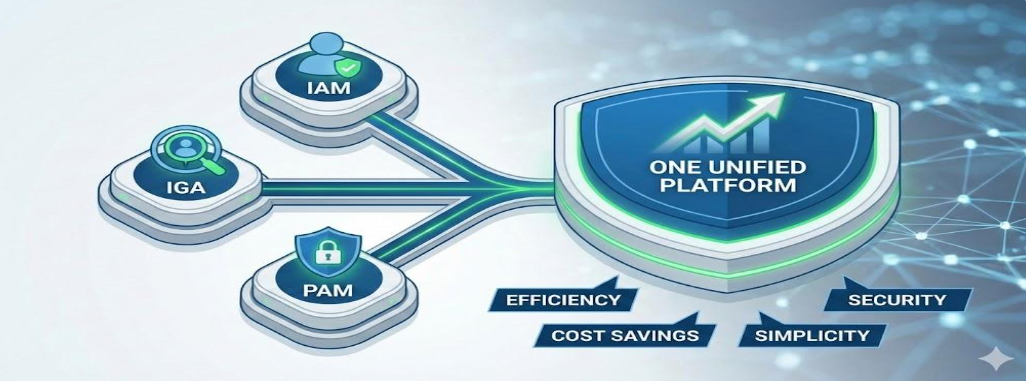
Most security leaders already know something is wrong with their identity stack. They just can’t always articulate it. They look at reports from IAM, certifications from IGA, and session logs from PAM, and none of it lines up cleanly. When you ask who can reach a sensitive system today, the answers drift depending on which tool you check.
This underlying disconnect between multiple data sources is what drives the change in an organisation’s overall risk profile when IAM, IGA, and PAM are consolidated into one cohesive platform. The risk associated with an organisation’s identity and access management is only fully realised and understood when integrating all identity management tools as one single system.
Why do separate IAM, IGA, and PAM cause false confidence?
Separate tools create three overlapping stories about the same person. Each story is internally consistent and omits something the others contain. When you try to produce a single answer, the gaps show up as delay, missing evidence, or stale access.
Organizations usually end up here for sensible reasons. Teams solve immediate problems by buying the right tool at the right time. Over years the tools collect connectors and one-off scripts. The infrastructure works well enough to avoid panic. That is precisely why risk accrues quietly.
Two facts to keep in mind. First, credential-based attacks remain a dominant entry method for adversaries. Second, when incidents occur, faster containment reduces cost. IBM’s Cost of a Data Breach 2025 shows average breach costs near $4.44 million and links faster containment to lower impact.
The practical takeaway is, if your identity controls cannot describe every route to a critical asset in one place, you are running a guessing game in a high-stakes arena.
What do people miss when they discuss convergence?
Most teams concentrate on integration success, e.g., less tickets, easier onboarding, and easier audits (which are valid). However, there are three less talked-about areas, to be addressed, that affect real-world impacts of integration success.
- Hidden permission reappearance.
Cleanups often produce a short-term drop in risky access. Provisioning workflows, automated role grants, and service accounts can reintroduce those rights over weeks or months. If you don’t measure the reappearance rate, how many removed paths return within a set window, say 30 days, which is the number of removed paths that return within a set window, such as you’ll keep chasing symptoms instead of fixing the workflows and service principals that regenerate risk.
- Cross-domain escalation paths.
Attackers chain small privileges through cloud roles, SaaS admins, and management agents. When you keep governance and privileged controls separate, you cannot map those chains reliably. A consolidated model finds these links.
- Machine identity skew.
Machine accounts and service principals are multiplying. They move data, call APIs, and hold credentials. Most IGA programs were built for people. A single platform that treats machines and humans as first-class identities exposes the machine-driven risk many programs miss.
Measure these three areas and you will see whether your program is maturing or just changing labels.
7 Core Benefits of Consolidating IAM, IGA, and PAM
1. You finally get one reliable view of who can reach what
When identity data lives in three different systems, no one truly knows the full extent of a user’s reach. Consolidation gives you one identity graph that shows direct access, inherited rights, cloud permissions, and privileged paths in the same place. This removes the guesswork that usually plagues access reviews, incident response, and audit preparation. The real benefit isn’t visibility for its own sake, it’s the ability to spot escalation routes that were impossible to trace when IAM, IGA, and PAM were disconnected.
2. Lifecycle changes flow consistently instead of drifting across tools
With separate systems, an HR update may hit IAM first, then slowly propagate to IGA, and never reach PAM in time. That delay creates lingering access. A consolidated platform applies a lifecycle event everywhere at once. When someone joins, moves, or leaves, their login rights, entitlements, cloud roles, and privileged access update together. This eliminates the silent lag that leads to orphan accounts and outdated permissions.
3. Incident response becomes faster and more predictable
In a fragmented environment, blocking a risky user requires multiple teams acting across multiple consoles. You disable MFA here, remove groups there, rotate vault passwords somewhere else. In a converged setup, freezing an identity shuts down sessions, tokens, admin rights, and cloud entitlements in one action. Faster containment directly reduces breach impact, and consolidation is what makes that speed possible.
4. Reviews and certifications start using real access, not approximations
Most organisations struggle with access reviews because the data is incomplete. IGA may show an entitlement, but PAM may show sessions tied to a different identity, and IAM might still allow login. A single identity platform ends this mismatch. Reviewers see exactly what a user can reach and how they used it, which makes approvals meaningful again and cuts down on rubber-stamping.
5. Connector work drops dramatically and reduces misconfigurations
A unified system reduces the repetitive connector work identity teams perform across IAM, IGA, and PAM. Instead of building and maintaining separate adapters or duplicate mappings for the same application, you maintain one connector that supplies authentication, lifecycle events, entitlement mappings, and privileged controls. That single-source approach reduces onboarding time and the misconfigurations that appear when each tool interprets entitlements differently.
6. Gaps between human and machine identities become visible
As machine identities grow across cloud and automation workflows, many organisations struggle to govern them properly. Consolidation removes the divide. Machine accounts sit in the same model as humans, and their permissions follow the same lifecycle, monitoring, and clean-up processes. This reduces the silent risk created by service accounts and API keys that rarely get reviewed when tools operate in silos.
7. Audit evidence finally aligns with operational reality
Auditors want a clean timeline of access, approvals, usage, and removal. Fragmented tools produce conflicting timelines that someone has to reconcile manually. When IAM, IGA, and PAM share one source of truth, the audit story becomes straightforward. Every entitlement and privileged action ties back to one identity record. This reduces audit fatigue and makes compliance less dependent on spreadsheets and manual checks.
How to test whether a platform is truly converged?
Vendors love demos. Use the demo to test architecture, not features. Ask for these five proofs and demand to see them in action.
- Path map: Can the platform show every route a user has to a named sensitive system including cloud and service accounts? If the vendor fumbles here, they are not unified.
- Freeze test: Can you freeze a user and observe immediate revocation of tokens, sessions, and admin rights? If the demo relies on manual scripts, note it.
- One connector claim: Add a sample SaaS app. How many manual steps to have login, lifecycle, and privileged controls working? One meaningful connector is the goal.
- Reappearance check: Show a recent cleanup and its reappearance rate. Can the platform measure how many removed paths returned in 30 days? If it cannot, you will be blind to governance rot.
- Audit export coherence: Produce an audit report that answers: who had access, who approved it, when did the user use it, and which privileged sessions exist for that entitlement. The output must align with the entitlement view.
If vendors cannot demonstrate these in a live scenario, ask if they provide POC scripts to validate in your environment. A real converged platform survives those tests.
Where ObserveID fits in this conversation?
ObserveID merges IAM, IGA, PAM, and cloud-entitlement management (CIEM) into a single identity-security platform, giving you one place to see all identities, permissions, and access paths, whether human or machine, cloud or on-prem. This converged model removes the risk of disjointed admin rights and hidden permissions that slip through when tools live in silos. You get continuous monitoring, automated governance, and a “single pane of glass” that shows who can do what, across every system, in real time.
On top of that, ObserveID automates key identity operations that are usually manual, slow, and error-prone. It supports automated access reviews, AI-assisted detection of risky behavior and entitlement drift, and instant revocation of privileges when required. This means fewer orphan accounts, faster compliance reporting, and privilege cleanup that actually sticks, reducing both security risk and operational overhead while giving audit-ready visibility from day one.
Conclusion
If identity and access are scattered across several tools, you’re always playing catch-up with risk. ObserveID fixes that by uniting identity infrastructure under one roof, giving you complete visibility, cleaner governance, and faster control over access across every environment. For any org serious about visibility and accountability, this kind of convergence isn’t optional. It’s essential.
If you want to see this level of clarity in your own environment, book a quick demo with us, today.
FAQs (Frequently Asked Questions)
1. How do I know if my identity stack is too fragmented?
If IAM, IGA, and PAM give different answers about who has access, or if offboarding, reviews, and privilege cleanup require multiple tools, your stack is fragmented. Drift, divergence between systems where permissions, group membership, or entitlements change in one tool but not another (for example, stale group membership, reappearing rights after cleanup, or mismatched audit logs), duplicate connectors, and inconsistent audit data are the biggest signs.
2. What is the simplest way to compare IAM, IGA, and PAM platforms?
Test how each platform handles one user: their login rights, entitlements, cloud roles, and privileged access. If you need separate workflows or separate views to see the whole picture, the platform is not truly converged.
3. How do I map indirect access paths in a hybrid environment?
You need a single identity graph that includes AD groups, cloud roles, SaaS permissions, machine accounts, and delegated rights. Without a unified model, indirect access paths stay hidden.
4. How do machine identities affect my privilege model?
Machine identities often have broad, long-lived permissions and almost no review cycle. They can create silent escalation paths if they aren’t tracked and governed alongside human accounts.