
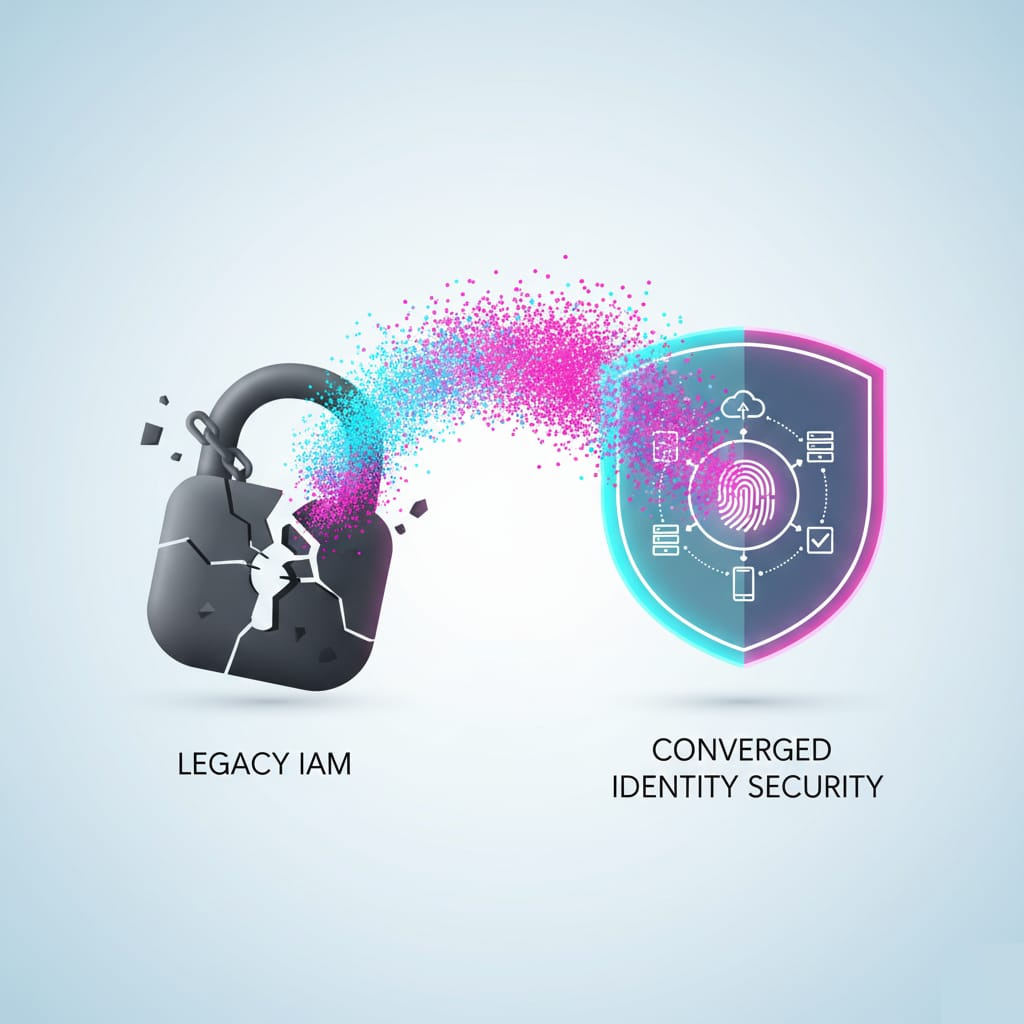
Most identity leaders know their tools work. The real question is whether those tools work together. As your organisation adds more apps, more users, and more automation, the gaps between IAM, IGA, and PAM start to matter more than the strengths of each system on its own.
Converged identity security is about closing those gaps. It gives you one view of access, one place to understand change, and one way to confirm what happened when something needs proof. Not because the old model failed, but because the scale and speed of today’s environments outgrew it.
This blog shows what that shift unlocks, why it improves control without disrupting what you already run, and how a unified approach turns identity from a collection of tasks into a source of clarity for security, audit, and leadership.
What is converged identity security?
Converged identity security puts access management, governance, privileged controls, and cloud entitlement visibility into one platform that uses a single identity model and one audit trail. The point is not to rebrand capabilities, but to stop asking three systems the same question and getting three different answers. One timeline answers auditors, investigators, and leaders at once, and that changes decisions from opinion to evidence.
How does converged identity security improve daily operations?
A converged model changes more than the architecture. It changes how work flows through your teams.
What becomes clearer for security and IT
You gain a complete, chronological view of each identity. You can see who approved access, how rights changed over time, when privileges were used, and whether that use aligned with policy. This shortens investigations and reduces the hours spent validating assumptions during incidents.
What becomes easier for managers and reviewers
Approvals become informed instead of instinctive. Managers see recent use, associated risk, and business context inside the approval screen. That reduces over permissioning and prevents stale access from surviving review cycles.
What becomes predictable for operations
You build one connector per system instead of separate connectors for IAM, IGA, and PAM. This reduces sync failures and removes the recurring cost of maintaining three integration paths for every application.
These are not cosmetic improvements. They change the quality and the speed of identity decisions across the organization.
How does a converged model solve privilege creep and reduce hidden exposure?
Privilege creep rarely comes from one event. It comes from slow accumulation. Temporary rights that turn permanent. Project roles that never expire. Service accounts that stay active because nobody wants to break a workflow.
A converged platform applies lifecycle rules uniformly. It notices when rights stop matching the role. It flags unused privileges. It drives expiry on temporary access. It allows just in time access flows for high-risk actions. This approach mirrors guidance in Saviynt’s work on zero standing privilege. Standing access should be rare. Time limited access should be the norm.
The combination of usage visibility and expiry rules prevents the slow build up that creates hidden exposure.
Where does convergence deliver measurable impact first?
You should expect improvements in three areas.
Audit readiness
Because all identity events share one audit trail, risks and approvals appear together. Evidence gathering moves from days of manual collection to one export that explains the full context.
Faster resolution during incidents
When security analysts can pull the full identity timeline in one place, they no longer trace usage across three tools. That shortens containment time and reduces confusion during active response.
Operations stability
With fewer connectors and one policy model, changes propagate consistently. Breakage decreases and integration work becomes predictable.
What is the right way to adopt convergence without disrupting running systems?
The shift does not require a hard cutover. A safe, proven adoption path looks like this.
Step 1. Ingest all identity, entitlement, and usage data into the converged platform. Do not enforce yet.
Step 2. Validate mapping accuracy and detect role inconsistencies.
Step 3. Move approval flows so context and usage appear directly in the decision.
Step 4. Apply expiry and just in time access for sensitive rights.
Step 5. Migrate enforcement in stages once the underlying model is stable.
Step 6. Extend lifecycle control to machine identities and service accounts.
This method allows quick wins in visibility while keeping operational risk contained.
What measurable improvements should you expect in the first 90 days?
Target these three outcomes and measure them.
- Audit report time. Move from days of manual reconciliation to hours of one-export proof.
- Discovered stale privileged accounts. The visibility alone will reveal accounts you did not know existed.
- Connector incidents. Expect a drop as you move from multiple connectors per app to a single integration approach.
How ObserveID helps as a converged identity model
ObserveID is built as a converged platform that unifies IAM, IGA, PAM, CIEM, and entitlement discovery into one model. It automatically discovers identities and entitlements across cloud and on-prem sources, offers one connector per app, and stores approval and usage data on a single timeline for every identity. The platform supports policy definition, automated access reviews, and audit-ready reporting from the same interface. These capabilities reduce connector work, surface mismatches quickly, and provide one consistent export for compliance teams.
If you want a practical pilot, ingest entitlements for one business unit and ask for a one-query timeline on five identities. That will prove value quickly and produce an audit-ready export to validate control.
Conclusion
Identity risk is a story about change. Rights matter less in isolation than the way they are granted, used, and retired over time. If you cannot tell that story quickly and reliably, you will keep chasing incidents. Converged identity security gives you that story as one record. That converts promise into proof.
If you want to see converged identity security in action on your own data, book a demo with us today.